July 7, 2026 · Updated September 25, 2026
Answer Engine Optimization (AEO): The Complete Guide for Canadian Businesses

TL;DR
More and more people get their answer from AI before they ever click a website. Answer engine optimization is how your business becomes the answer those tools give. Here's what AEO is, how it works, and what to actually do about it.
In This Article
A growing share of the people looking for what you sell never see a list of blue links anymore. They ask ChatGPT, they search Google and read the AI summary at the top, they ask Perplexity or Gemini, and they get a direct answer with a few sources named. If your business isn't one of those named sources, you're missing from the answer they see first, even if you rank perfectly well in the links below it.
Answer engine optimization, usually shortened to AEO, is the work of making your business the answer these AI tools give. Traditional SEO is about ranking a page so someone clicks it. AEO is about being the source the AI trusts enough to quote. This guide explains what answer engines are, how they decide who to cite, how AEO relates to the SEO you may already be doing, and the specific things a Canadian business can do to show up.
One note before we start. This is a fast-moving area, and a lot of the published advice is guesswork dressed up as certainty. We have tried to stick to what is observable and durable rather than chasing every tactic that trends for a week.
What Is Answer Engine Optimization?
Answer engine optimization is the practice of structuring your content and your wider online presence so that AI answer engines can find it, trust it, and cite it when they respond to a question. In plain terms, when someone asks an AI tool a question your business could answer, AEO is what makes your business the one it mentions.

An "answer engine" is any tool that gives a direct answer instead of a list of links. The ones that matter most right now are:
- Google AI Overviews: the AI summary that appears at the top of many Google searches.
- Google AI Mode: Google's separate conversational search experience, reached from the results page or directly at google.com/ai, and available in English in Canada since 2025.
- ChatGPT: which now searches the live web when a question calls for current information, not just its training data.
- Perplexity: a search-first AI tool that cites its sources inline with numbered references.
- Claude: Anthropic's assistant, widely used for research and writing, which can also search the web and cite the sources it draws from.
- Google Gemini and Microsoft Copilot: the AI assistants built into Google and Microsoft products.
The shift underneath all of this is simple. Search is moving from "show me the options" to "just tell me the answer." Studies have estimated for years that more than half of Google searches end without a click, and AI answers continue that shift. When the answer on the screen is good enough, the click never happens. AEO is how you stay in the conversation when the click disappears.
AEO vs SEO: What's Actually Different
The short version: AEO doesn't replace SEO, it sits on top of it. They share most of the same foundation and differ mainly in the goal.
Traditional SEO aims to rank your page in a list so a person clicks through to your site. The win is the visit. AEO aims to get your content extracted and quoted inside an AI answer. The win is being named as the trusted source, whether or not the person clicks.
Here's the part people miss. The two are deeply connected. Google AI Overviews draw from the same search index as regular Google results, so a page Google doesn't index or trust has little chance of being pulled into the AI answer. Ranking well helps, though a 2026 Ahrefs study found most cited pages weren't in the top 10 for the exact query. If your site is hard to crawl, slow, thinly linked, or technically broken, your AEO will suffer for the same reasons your SEO does. You can't skip the fundamentals and AEO your way to visibility. Solid search engine optimization is the price of admission, and AEO is the layer you build on top.
How Answer Engines Decide What to Cite
No AI company publishes its exact recipe, and each engine works a little differently. But across the major ones, a consistent set of signals shows up. These are the things worth paying attention to.

Can the AI actually read your page?
Answer engines favour content they can extract cleanly. A clear question-and-answer structure, descriptive headings, short direct paragraphs, lists, and tables all make it easy for an AI to lift a specific passage and quote it. A wall of text with the answer buried in paragraph nine is hard to extract, so it gets skipped in favour of a competitor who put the answer up front.
Does the wider web agree about who you are?
AI tools look for corroboration. Before confidently naming your business, they tend to look for the same information about you showing up consistently across multiple independent places: your own site, your Google Business Profile, directories, review sites, and any press or mentions. When your name, what you do, and where you operate all line up across the web, you're an easier source for an AI to trust. When the details conflict, that mixed signal makes it more likely to go with someone else.
Is the content recent and credible?
Freshness carries real weight, especially for questions where the answer changes over time, and AI engines lean toward recently updated pages for those. For stable, evergreen topics, authority still tends to win out. Credibility signals matter too. A named author with real expertise, clear sourcing, and a site with genuine authority in its field all make a page more quotable.
Does it already rank in regular search?
For Google AI Overviews specifically, ranking in normal search helps, because they pull from the same index. Google also searches related questions behind the scenes, so pages that rank for those can get cited too. This is the clearest link between old-fashioned SEO and the new AI layer, and it's why the two can't be treated as separate projects.
One thing worth knowing is that the different engines don't all cite the same sources, so being quoted by one doesn't guarantee the others will quote you too. The good news is that the work that earns citations, namely clear answers, a consistent presence, and credibility, tends to help across all of them.
How to Optimize for Answer Engines
Here's the practical playbook. None of it requires gaming anything. It's mostly about being genuinely useful and easy to quote.
Answer the question first
Lead with the answer, then explain. If a page is about how much a website costs, the first sentence should give a real range, and the rest of the page should expand on it. Google says outright that you don't need to write in a specific way just for generative AI search, so treat answer-first structure as good writing rather than a lever that triggers citations. It works because the reader gets what they came for immediately, and Google does note that people appreciate pages organized into sections with headings that give clear structure.
Free Offer
Want to know what's hurting your website?
We'll review your site and tell you exactly what to fix, no strings attached.
Get Your Free AuditStructure content so it can be extracted
Use descriptive headings phrased the way people actually ask questions. Break complex topics into short sections. Use lists and tables for anything comparative. Add a genuine FAQ section to pages where people have natural follow-up questions. The easier your page is for a person to skim, the easier it is for an AI to quote.
Add schema markup
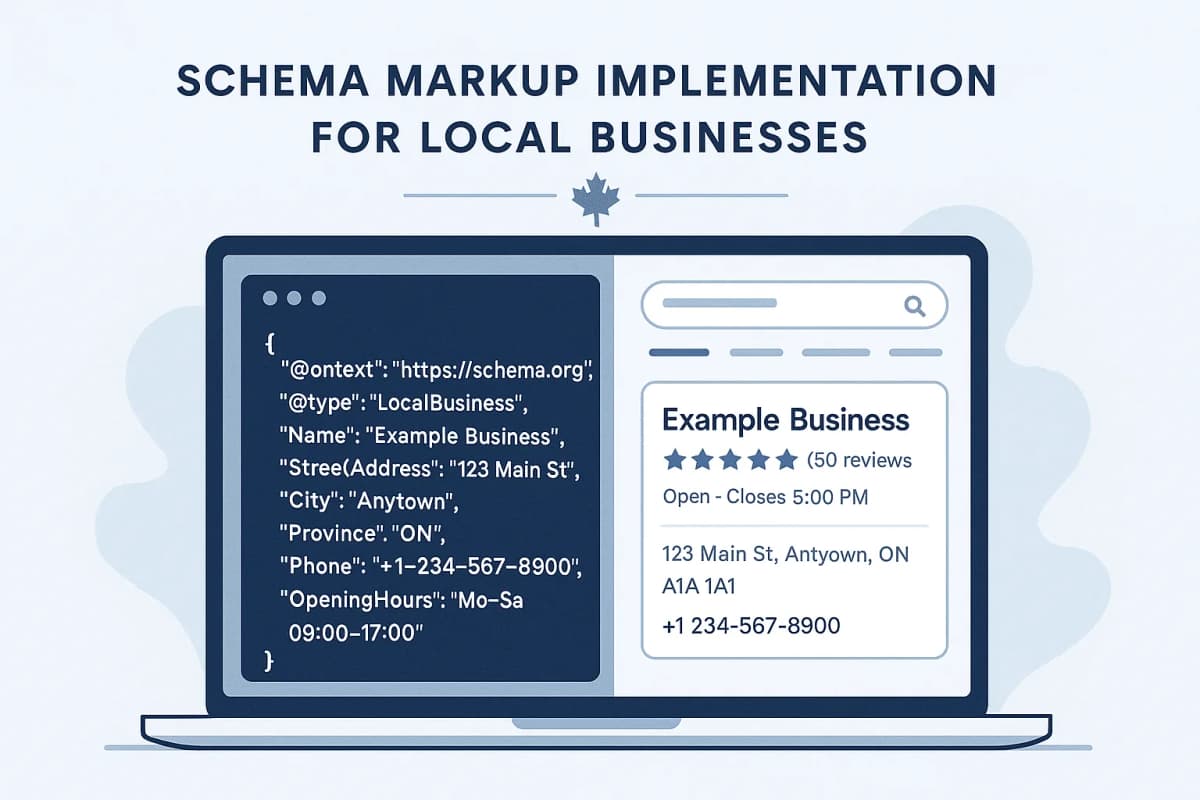
Schema is structured data that tells search engines exactly what your content is: a business, a product, an FAQ, an article, a review. It's worth doing, but be careful how much weight you put on it for AI specifically. Google's own guidance says structured data isn't required for generative AI search and that there's no special schema.org markup you need to add. Google still recommends keeping it as part of your overall SEO strategy, where it makes you eligible for rich results and removes ambiguity about your business. Treat it as foundation work that helps you get found, not as a lever that buys AI citations. Our guide to schema markup for Ontario businesses covers how to set this up.
Build a consistent presence across the web
This is where local businesses can win. Make sure your business name, address, phone number, and description read the same everywhere they appear: your site, your Google Business Profile, and the directories that list you. Encourage genuine reviews. Get mentioned on the sites your customers and your industry actually read. Consistent mentions in those places make it easier for an AI to confirm you are who you say you are. A complete, well-managed Google Business Profile does a lot of this heavy lifting for local AI answers.
Keep your best content current
Revisit the pages that matter most and update them when the facts change. An article last touched three years ago is less likely to be quoted than one refreshed this year, especially for questions where the answer moves over time.
Don't neglect the SEO basics
Make sure your site is fast, mobile-friendly, crawlable, and properly indexed. If an AI's crawler can't reach or read your page, none of the above matters. Crawling isn't the only switch anymore, though. Since June 2026 Search Console has carried a Search generative AI setting that decides whether your site can appear in AI Overviews, AI Mode, and the generative AI features in Discover, and it's now available to every site. It defaults to including you and switching it off won't affect how you rank in the rest of Search, but an excluded site gets no traffic and no impressions from those features at all, so check under Settings that it's set to include. The fundamentals of good SEO are the foundation AEO is built on, not an optional extra.
What This Means for a Local Business
If you run a local or service business, the temptation is to assume AI search is something only big national brands need to worry about. The opposite is closer to the truth. When someone asks an AI assistant for the best provider of your service in your city, it builds that answer from business listings, reviews, your website, and what the rest of the web says about you. Google's tools lean on your Google Business Profile, while ChatGPT leans on directories like Foursquare and Bing Places. Those are all things you can influence directly, and many of your local competitors aren't paying attention to them yet.
The businesses that show up in AI answers a year from now are the ones doing the unglamorous work today: a clear website that answers real questions, a complete and accurate Google Business Profile, steady reviews, and consistent information everywhere they appear online.
How Do You Measure AEO?
Honestly, measurement is still catching up, and anyone who tells you it's a solved problem is overselling. A few things help today. Google Search Console counts your appearances in AI Overviews and AI Mode inside your overall Search totals, and since June 2026 it also has a dedicated generative AI performance report that breaks those impressions out on their own, grouped by page, country, device, or date. It's now available to all sites, though you won't see it if your site has had few AI impressions, and it reports impressions only, with no clicks, no click-through rate, and no query data behind them. Visits from tools like ChatGPT and Perplexity often show up with a recognizable source, which can make them easier to spot, though some arrive with no referrer at all and land in your direct traffic instead. In Google Analytics, recognized AI assistants now fall under their own channel rather than plain referral traffic. Beyond the analytics, periodically ask the major engines the questions your customers would ask and note whether you get named, and keep an eye on your brand mentions across the web. It's more manual than traditional rank tracking, but it tells you whether the work is landing.

Frequently Asked Questions
Is AEO the same as GEO?
Mostly, yes. AEO (answer engine optimization) and GEO (generative engine optimization) are two names for nearly the same thing, getting your content surfaced and cited by AI-powered answers. Some people use GEO to emphasize generative tools like ChatGPT and AEO to emphasize direct-answer features like AI Overviews, but in practice the work overlaps almost entirely. Don't get hung up on the labels.
Does AEO replace SEO?
No. AEO is a layer on top of SEO, not a replacement for it. Most of what earns AI citations, namely a fast and crawlable site, content that ranks, and clear structure, is exactly what good SEO delivers. If you stop doing SEO, your AEO falls apart with it.
How long does AEO take to work?
There's no fixed timeline, and it depends on where you start. If your site already ranks well and is structured clearly, you may begin showing up in AI answers fairly quickly. If you're starting from a thin or technically weak site, the foundational work comes first and the AI visibility follows. Treat it like SEO: a compounding investment, not a switch you flip.
Can a small business actually compete in AI search?
Yes. AI tools name only a handful of businesses per answer, so the spots are few, but many local competitors haven't started working on them yet, and the signals that matter (consistent business information, real reviews, clear answers to specific questions) are entirely within reach of a small business. You don't need a huge budget. You need to be genuinely useful and easy for a machine to understand.
What is an answer engine?
An answer engine is any tool that responds to a question with a direct answer rather than a list of links. Google AI Overviews, ChatGPT, Claude, Perplexity, Gemini, and Copilot are all answer engines. They're increasingly where people start, and often finish, their search.
Showing up in AI answers starts with the same foundation as everything else: a site that's fast, clear, easy to crawl, and genuinely helpful. If you're not sure where your business stands, a free website audit is a good first step. We will look at how your site performs technically, how your Google Business Profile and local presence stack up, and where your content is and isn't set up to be found by both search engines and answer engines. From there you will know exactly what to fix first. No pressure, just a clear picture of where you stand as search keeps changing.