September 1, 2026 · Updated September 25, 2026
Local Lead Generation: Where Your Next Customers Come From
TL;DR
Most local service-business leads come from a short list of channels you can control. Here is where your next customers come from, what to prioritize on a small budget, and how to track it.
In This Article
If you run a local service business, a plumbing company, a law office, a clinic, a landscaping crew, your leads almost always come from a short, predictable list of places. Search results and your Google Business Profile. A website that turns a visitor into a phone call. Reviews and word of mouth. The occasional paid ad. And the customers you already have, coming back or sending a friend.
That's the honest answer most articles dance around. There's no secret channel that suddenly fills your calendar. Lead generation for small business is mostly about being easy to find when someone is ready to buy, easy to choose when they compare you to other options, and easy to contact when they decide. You can control all three on a modest budget. This article walks through where local service leads come from, channel by channel, what to prioritize when money is tight, and how to track which channels work so you stop guessing.
Where do local service-business leads come from?
For most local service businesses, the bulk of new enquiries come from a handful of sources. The exact mix shifts by industry and town, but the shortlist is short:

- Local search and your Google Business Profile, where someone searching "emergency electrician near me" often sees a short list of map listings near the top of the results.
- Your website, which most people check before they call, however they found you.
- Reviews and referrals, often your highest-quality leads because trust is already there.
- Paid ads, which buy visibility quickly when you need leads this month rather than next quarter.
- Email and repeat business, the cheapest leads you own.
Notice what isn't on that list: viral content, complicated funnels, or chasing every new platform. Those can work for some businesses, but they're rarely where a local service company should start. Begin where buyers are already looking.
Your Google Business Profile and local search
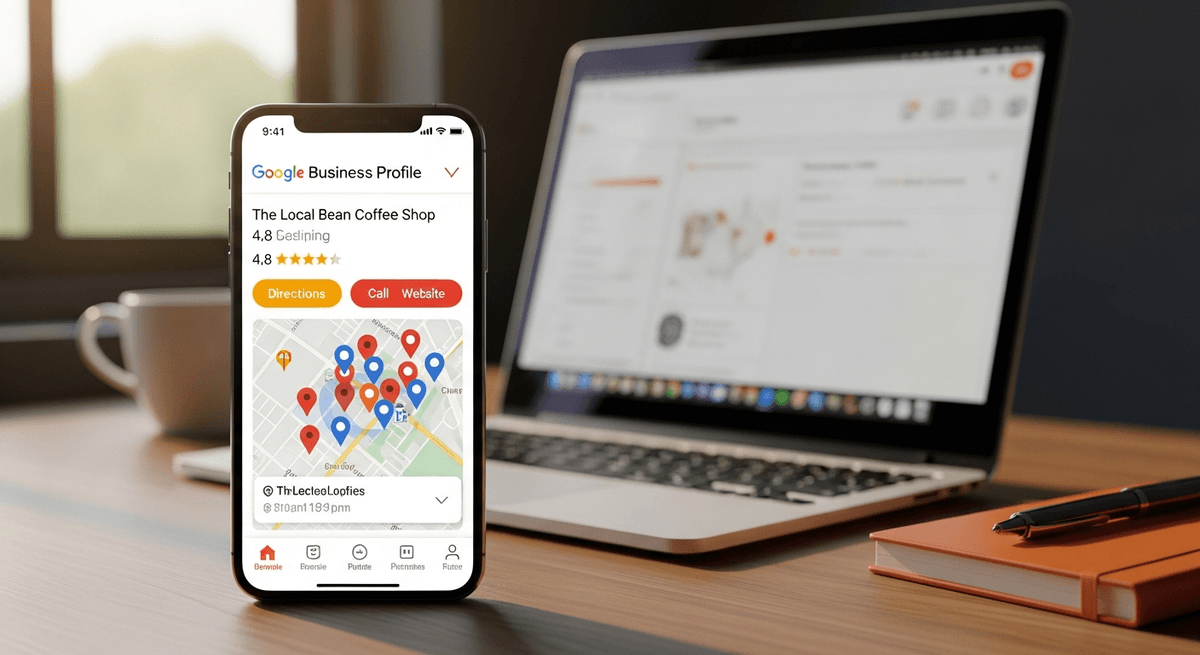
For a business that serves a specific area, your Google Business Profile is usually the best place to put early effort. It's free, it can show up in the map pack near the top of the results, and a well-built profile gives someone everything they need to call, message, or find you.
If you do nothing else this month, claim and complete your profile. Add accurate categories, services and service areas, real photos, current hours and a clear description. Then keep it active, because profiles that get fresh reviews, posts, and updates tend to outperform ones left to sit. We cover the full setup in our Google Business Profile guide, and the deeper ranking factors in how to optimize your profile for local SEO.
Local search and your profile reinforce each other. The signals that help you rank in the map pack, accurate information, relevant content, and reviews, also help your website show up in regular results. Our breakdown of local SEO tactics and our search engine optimization service show how the pieces fit. One honest caveat. Search takes time. From scratch, plan on months before organic local visibility carries real weight, as we explain in how long SEO takes.
A website that converts
Here's a pattern we see constantly. A business spends money to get found, the traffic shows up, and almost nobody calls. The leak is rarely the traffic. It's the website.
A local service website has one job: make it obvious, fast, and easy for an interested visitor to contact you. That sounds basic, yet most sites get in their own way:
- The phone number is hard to find or not tappable on a phone, where most local searches happen.
- The page is slow. Every extra second of load time loses impatient visitors, and most of yours are on mobile.
- It's unclear what you do or where. A visitor should know your service and service area within a few seconds.
- There's no obvious next step. No clear button, no short form, no reason to act now.
Fixing these is what we mean by conversion rate optimization: the difference between a site that wastes your traffic and one that earns calls from it. If your phone isn't ringing despite decent traffic, our guide on why your website isn't getting phone calls is a practical start. When the site is dated or hard to update, that's a website design conversation, and our piece on what a website costs in Canada sets honest budget expectations.
Before you spend more to drive traffic, make sure the traffic you already have can become a lead. A cheap fix to a leaky site often beats a new ad campaign.
Reviews and referrals: the leads that close themselves
Reviews and referrals do double duty. They generate leads, and those leads close at higher rates because trust is there before anyone reaches out. Reviews influence both whether people choose you and whether Google shows you. A business with forty recent, detailed reviews looks like a safer choice than one with four. The practical move is to ask, consistently and right after you have done good work. We put together ten proven ways to get Google reviews you can turn into a simple routine. The goal isn't a one-time push. It's a steady drip that keeps your profile fresh.

Referrals are the leads you're probably leaving on the table. Most happy customers would recommend you if asked, but few do unprompted. Make it easy with a thank-you note that mentions you appreciate referrals, a small incentive where it suits your industry, or just the habit of asking. Referred customers usually arrive pre-sold, which makes them among the most valuable and cheapest leads you can get.
For more on building demand without buying it, see getting more clients without ads, and how you show up across review sites ties into online reputation management.
Where do paid ads fit?
Paid advertising gets oversold to small businesses, so here is where it helps. Ads buy speed. When you need leads now, a new location, a slow season, a gap in the calendar, they put you in front of buyers faster than waiting for rankings. A few options matter:
Free Offer
Want to know what's hurting your website?
We'll review your site and tell you exactly what to fix, no strings attached.
Get Your Free Audit- Google Ads (search). You bid to appear when people search for your service. Intent is high, but costs per click can be steep in competitive trades, so it's worth it when your average job value justifies the spend. Our Google Ads management service exists because the wrong settings burn a budget fast.
- Local Services Ads. For eligible categories, these appear at the very top with a verification badge and charge per lead rather than per click, which many service businesses find easier to reason about. Availability depends on your industry and area.
- Social ads. Useful for awareness and for services people don't search for urgently. Lower intent than search, so set expectations accordingly. This is part of our social media marketing work.
The honest framing is that ads are rent, not equity. The leads stop when the spending stops, while your profile, reviews, and website keep working after the ads go dark. So if your budget is small, treat ads as a top-up for the channels you own, not a replacement. For how to split a limited budget, see setting a small business marketing budget in Canada.
Email and repeat business: your cheapest lead source
The customers you already have are the easiest people to sell to, and most local businesses barely market to them. Email and simple follow-up turn one-time buyers into repeat ones and prompt referrals you would otherwise miss. You don't need a complicated program:
- Capture the email at the point of service, with permission, so you can reach people again.
- Send seasonal reminders that match your service, like a heating company before winter or a lawn-care crew in spring.
- Follow up after a job to ask for a review and mention what else you offer.
- Stay in touch lightly so you're top of mind when the need comes up again.
Done with restraint, this is some of the highest-return marketing you can do, at close to no cost. When you're ready to automate the reminders and follow-ups, that's where email marketing and marketing automation fit.
What should you prioritize on a small budget?
If money and time are tight, don't spread yourself thin. Build in order. Fix the foundation, then add reach. A sensible sequence for most local service businesses:
- First, your Google Business Profile. Free, high-intent, and visible. Claim it, complete it, keep it active.
- Second, your website's ability to convert. Make the phone tappable, the page fast, the next step obvious. Fixing leaks here multiplies every other channel.
- Third, a review and referral habit. Build the routine of asking. It compounds and costs little.
- Fourth, email and repeat business. Capture addresses and follow up. Cheap, durable, often ignored.
- Last, paid ads. Add them once the owned channels work, or sooner if you need leads this week and can afford to test.
This order is deliberate. The first four are things you own. Money spent on ads leaks out the bottom if your profile, site, and follow-up are weak, so strengthen the foundation first.
How do you track where your leads come from?
You can't improve what you don't measure, and "I think most people find us on Google" isn't measurement. For every lead, know roughly where it came from, so you can put more into what works and stop funding what doesn't. You don't need an expensive setup. A few habits cover most of it:

- Ask every new lead how they found you. Low-tech, surprisingly accurate, and it catches word of mouth that no software will. Add one field to your intake form or one line to your phone script.
- Set up conversions in Google Analytics 4. Mark form submissions and click-to-call taps as key events so you see which channels drive contacts, not just visits.
- Tag your links. Add UTM parameters to ad, email, and social links so traffic from each shows up labelled. Tag only external links pointing to your site.
- Track phone calls. Many local leads call rather than fill out a form. Click-to-call tracking, or a dedicated call-tracking number, tells you which channel earned the call. For many local businesses it is the missing piece in lead measurement, because so many enquiries skip the form.
A practical note for 2026 is that browser privacy changes and ad blockers have made purely automatic tracking less complete than it used to be, which is exactly why the low-tech "how did you hear about us" question still earns its place. Tracking doesn't have to be perfect to be useful. It has to be good enough to stop you funding the channel that isn't pulling its weight.
Frequently Asked Questions
What is the fastest way to get more leads for a small business?
The fastest reliable move is usually a complete, active Google Business Profile combined with a website that makes it easy to call, since both reach people already searching for what you do. If you need leads within days, paid search or Local Services Ads buy visibility quickly. Treat that as a top-up while you build the channels you own.
How much should a local service business spend on lead generation?
There's no single right number, and beware anyone who gives you one without knowing your margins. Spend should track your average job value and how many new jobs you can handle. Many small businesses start by fixing free and low-cost channels first. We cover how to set a figure in our guide to small business marketing budgets in Canada.
Are paid ads worth it for a local service business?
They can be, when your average job is valuable enough to absorb the cost per lead and your website and follow-up convert what the ads send. Ads are best for speed and filling gaps. The catch is that leads stop when spending stops, so they work best alongside the channels you own, not instead of them.
Do I need a new website to get more leads?
Not always. Sometimes the site just needs the leaks fixed: a tappable phone number, faster load times, a clearer offer, an obvious next step. If your site is old, slow, or impossible to update, a rebuild may pay for itself. The honest way to find out is to look at the numbers first. A free website audit tells you whether you have a traffic problem or a conversion one.
If you have read this far, you already know lead generation for a local service business is less about chasing the newest tactic and more about getting the fundamentals working together: a strong profile, a site that converts, reviews and referrals, smart use of ads, and a habit of staying in touch. If you want a clear read on where your leads are leaking and which channels would help most, grab a free website audit. We will show you what is working, what is quietly costing you customers, and where to start.