March 17, 2026
Invisalign Marketing for General Dentists: Building a Real Aligner Pipeline
TL;DR
Invisalign is one of the highest-margin cosmetic cases a general dentist can offer, but most practices market it like a routine cleaning. The result is wasted ad spend and low case acceptance. Here's how to build an Invisalign pipeline that competes with orthodontists without pretending to be one.
In This Article
Invisalign sits in an unusual spot on a general dentist's schedule. The treatment is largely elective, the patient has often been thinking about it for months or even years before they call, and the decision is part clinical, part cosmetic, part financial. Insurance coverage is less of a factor than people assume. Most Canadian employer extended-health plans cover orthodontic treatment for dependents (typically under 18 to 21), but adult orthodontic coverage is comparatively rare and usually only appears in extended or premium plans. When it does, it's commonly 50 per cent up to a lifetime orthodontic maximum of a few thousand dollars. That means for many adult Invisalign patients, the case is mostly self-pay. For some, a portion is covered. That combination of elective, considered, and partly self-pay is exactly what makes the marketing hard. The visitor researching Invisalign isn't comparing you to another general dentist down the street. They're comparing you to orthodontists, to clear aligner direct-to-consumer brands, and to the idea of waiting another year and doing nothing.
Most general dental practices market Invisalign as if it were another service on the menu: a line on the home page, a generic stock photo, and an offer to "ask us at your next cleaning." That approach quietly leaves money on the table. This article is about what a real Invisalign marketing program looks like for a general dental practice in Canada, what channels actually produce cases, and where the conversion bottleneck almost always lives.
For US dentists reading this, the marketing playbook is essentially the same on both sides of the border. Canadian and US patients respond to roughly the same channels and the same proof points. Most Canadian dollar figures convert to USD at roughly 0.72 to 0.77x at current exchange rates. The compliance considerations differ (HIPAA in the US, provincial regulators and college rules like RCDSO in Canada), and those differences matter most for what you can show in before-and-after content.
A note on any numbers in this article: case fees, conversion ranges, and case volumes are ballpark observations based on current market conditions in Canadian general dentistry, not published authoritative benchmarks. Treat them as planning anchors, not exact figures.
Why Invisalign Is a Different Marketing Problem Than General Dentistry
A patient searching "dentist near me" for a cleaning is solving a different problem than a patient searching "Invisalign Toronto." The cleaning patient wants convenience: location, hours, parking, insurance accepted. The Invisalign patient wants something closer to a cosmetic-procedure decision: trust in the clinician, evidence of similar cases, transparency on cost and timing, and a clear sense of what their teeth will actually look like after.
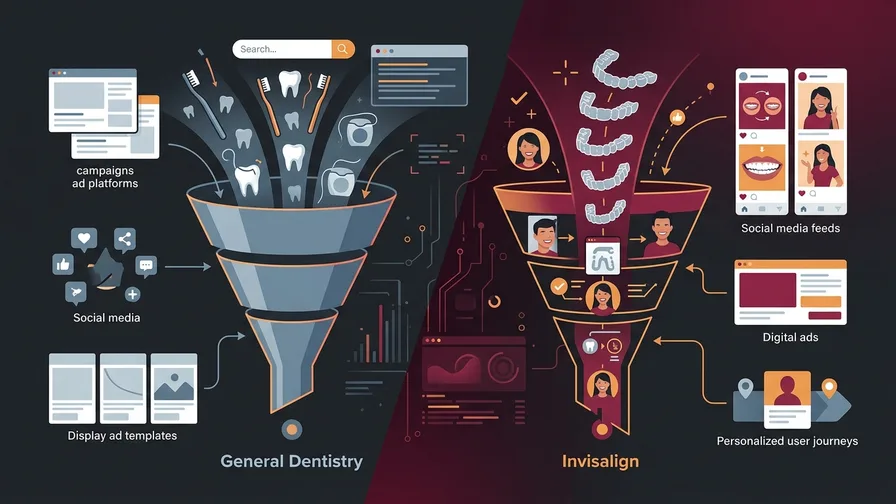
That difference shapes everything downstream:
- Longer consideration cycle. Many Invisalign patients research for weeks or months before booking a consult. They look at multiple practices, multiple orthodontists, and often a direct-to-consumer aligner brand before deciding.
- Higher case value. A typical Canadian Invisalign case runs $3,500 to $8,500 depending on complexity and region, with comprehensive cases in major metros commonly landing in the $5,000 to $7,500 range. Compared to a hygiene visit, the margin is meaningful.
- Premium ad costs. "Invisalign" keywords are bid heavily on Google Ads because of the case value, and Meta's cosmetic-treatment audiences are similarly competitive even though Meta targets by interest and audience rather than keywords. Your cost per click and cost per consult will sit higher than for general-dentistry queries on both platforms.
- Stronger trust signals required. Visitors want to see real before-and-after photos, real patient stories, and clinician credentials. Generic copy doesn't move them.
Treating Invisalign marketing as a sub-page of your general website is the equivalent of running it as a side hobby. It can still produce a handful of cases a year that way, but it won't produce a pipeline.
How General Dentists Compete With Orthodontists Without Pretending to Be One
Orthodontists position themselves on specialty: more cases, more complex cases, additional training in tooth movement. Some general dental practices try to compete by matching that positioning. It usually doesn't work, and it doesn't have to.
General dentists have legitimate, distinct advantages with the right patients:
- Continuity of care. The same practice handles their cleanings, fillings, and Invisalign. No coordinating between an orthodontist's office and a general dentist's office for ongoing maintenance.
- Comfort and familiarity. Existing patients already know the team, the room, and the front desk. Switching providers for several months to a couple of years of treatment, depending on the case, is a real barrier.
- Product tiers built around shorter cases. Invisalign Go and Lite are limited-scope aligner products (Go focuses on the anterior teeth with a smaller number of aligners; Lite is slightly broader) that Align actively markets to general dentists. Whether any specific case is the right fit for your practice versus a referral to an orthodontist is a clinical decision based on your training, the patient's case, and provincial scope of practice, not something marketing copy should pre-decide.
- Practical scheduling. Many general practices can fit aligner check-ins around hygiene visits, which patients prefer to a separate orthodontic appointment.
The honest positioning for general dentists is something like: "For straightforward cosmetic cases, we offer Invisalign Go and Lite as part of the practice you already trust. For complex orthodontic cases, we'll refer you to an orthodontist." That's defensible, accurate, and easier to market than trying to out-orthodontist an orthodontist.
What you should avoid is implying you're equivalent to a specialist when you're not. "Specialist" is a regulated title in Canada. Only dentists who have completed an accredited specialty program and are registered as specialists with their provincial college can use it. Language like "specialist in clear aligners" or "Invisalign specialist" can trigger a college complaint even if the intent was just marketing copy.
The Marketing Channels That Actually Bring Invisalign Cases
For a general practice running Invisalign as a real offering, four channels do most of the work. Most practices over-invest in one or two and ignore the rest.
1. A dedicated Invisalign service page (not a paragraph on your home page)
The single highest-leverage move most general practices haven't made is to build a proper Invisalign service page on the website, optimized for the local search query patients actually use ("Invisalign Toronto," "Invisalign Brantford," "clear aligners near me").
What the page needs:
- A specific headline tied to your city or region, not a generic "Invisalign in our practice" header
- Real before-and-after photos of your own cases, with consent, within college rules
- Honest case-fee ranges or starting prices (not "call for pricing"), so patients can self-qualify
- A short explanation of treatment time, how check-ins work, and what financing you offer
- A trust stack near the top: years of Invisalign experience, provider tier if applicable (Bronze through Diamond Plus), patient reviews, clinician name and credentials
- One primary call to action: book a consultation, with a click-to-call option as a clear secondary path
This is the page that should rank for your local Invisalign queries and the page that paid traffic should land on. If you're sending Invisalign ad clicks to your home page, you're losing conversions before the visitor reads a word about the service. We covered the broader version of this in dental PPC landing pages.
2. Google Ads for transactional Invisalign queries
Patients searching "Invisalign [city]" or "clear aligners near me" are at the bottom of the funnel. They're not researching whether Invisalign works. They're choosing a provider. Google Ads on these queries, pointing to a proper Invisalign landing page, converts well when the page and the offer are right.
A few things to plan for:
- Invisalign keywords sit among the most expensive dental search terms. Both cost per click and cost per consultation run materially higher than for routine general-dentistry queries. The specific numbers vary by city, season, and how competitive your local market is, so a campaign that pencils out in a smaller market may need a bigger budget in Toronto, Vancouver, or other major metros.
- The consultation is where the funnel narrows, not the landing page. Even with a strong landing page, a meaningful share of consult bookings don't convert to signed cases. That bottleneck lives in the consultation conversation, not in the ad campaign (more below).
- Plan to give the campaign time and budget to stabilize. A few weeks of data isn't enough to judge whether Invisalign ads are working in your market. Most practices need a few months of consistent spend, landing page tuning, and consultation-flow refinement before the cost-per-case settles into a predictable range.
3. Instagram and Meta Ads (the cosmetic angle)
Invisalign is one of the few dental services where Meta (Instagram and Facebook) consistently outperforms expectations. The reason is simple. It's a visual cosmetic outcome, and Instagram is where cosmetic decisions get made.
What tends to work:
- Real patient before-and-after content, with informed written consent, scoped to what your provincial college actually permits. Most provinces allow the photos themselves but restrict superlative claims and patient testimonial captions around them. Keep the captions descriptive, not promotional, and have your copy reviewed against your college's advertising guidance.
- Short clinician-led explainer videos about candidacy, timeline, and cost. Real human voice on camera beats polished marketing reels, and the clinician is talking about the treatment rather than asking patients to endorse it.
- Targeted Meta Ads in a tight geographic radius around the practice, to the age range and audience most likely to be considering cosmetic treatment, with a clear consultation offer.
- A simple landing page or booking flow from the ad. Sending Instagram clicks to a generic home page wastes the spend.
What tends not to work is boosted posts of stock smile photos with "Call us about Invisalign" captions. Patients scroll past them.
4. Your existing patient base
This is the channel most practices undervalue. Existing patients trust you, are already on your schedule, and a meaningful share of them have some level of cosmetic interest they've never voiced.
The mechanical version of this channel:
- Train the hygiene team to mention Invisalign during cleanings when they observe candidacy (mild crowding, spacing, alignment changes from grinding), framed as information rather than a sales pitch
- Offer a free consultation or complimentary scan to existing patients
- Send a once- or twice-a-year educational email or letter to the active patient base about Invisalign, with a real photo and a short paragraph, not a marketing graphic
- Track which hygienists and which appointments produce Invisalign conversations so you can learn from the patterns
For a moderately-active general practice with a meaningful existing patient base, an internally-generated Invisalign case every one to two months is a realistic target once the team is briefed and the conversation becomes part of the regular hygiene flow. The cost is mostly staff time, not ad spend.
The Consultation Is Where Cases Are Won or Lost
You can pour money into a perfectly tuned ad campaign, land the click on a beautiful landing page, and book the consult, and still lose the case in the chair. The consultation conversation is the conversion bottleneck for nearly every general practice running Invisalign.

The patterns we see in practices that convert well:
Free Consultation
Ready to get more from your marketing?
Book a free call and we'll look at what's working, what's not, and where to focus next.
Book a Free Call- iTero scan (or equivalent) at the consult, with the patient seeing a visual simulation of their projected outcome. Seeing the after image moves cases that pure conversation can't.
- A clear written treatment plan handed to the patient, including timeline, case fee, financing options, and what's included
- One primary clinician conversation, not a hand-off. The patient meets the dentist, not just a treatment coordinator
- A specific next step before the patient leaves: sign the plan today, sign later this week, or schedule a follow-up. Not "let us know when you're ready"
If your Invisalign ad campaign is producing consults but few signed cases, the answer almost never lives in the ad campaign. It lives in the consultation. That's usually the highest-impact thing to work on once the channels above are in place.
Financing and Payment Plans
For a treatment that lands between $3,500 and $8,500, the payment conversation matters as much as the clinical conversation. Most patients aren't writing a cheque for the full amount.
Standard options to offer:
- In-practice payment plans spread over the treatment period, if your practice offers them. Some practices run interest-free or low-interest plans internally. Others don't offer in-practice financing at all and route patients to a third-party provider instead
- Third-party patient financing like Dentalcard (iFinance), Medicard, or Affirm Canada (formerly PayBright). The third party pays the practice up front and takes on the patient receivable in exchange for a merchant fee, which converts the credit risk into a known cost rather than carrying it on your books
- Insurance coordination. Most Canadian employer plans cover orthodontic treatment for dependents but offer limited or no orthodontic coverage for adults. When adult coverage exists, it's typically 50 per cent up to a lifetime orthodontic maximum of a few thousand dollars. Predetermination of benefits submissions and clear explanations of what's covered vs. what's out of pocket are useful, but the practical answer for many adult Invisalign patients is "mostly self-pay"
The point isn't to push a specific financing product. The point is for the financing conversation to be specific and reassuring at the consultation, not a vague "we have payment plans available."
Provincial College and Regulatory Considerations
Invisalign marketing in Canada sits inside provincial regulatory frameworks (RCDSO in Ontario, the BC College of Oral Health Professionals, the Ordre des dentistes du Québec, and equivalents in other provinces). The rules differ meaningfully between provinces, so the specifics for your province matter more than any general summary. A few patterns hold broadly:
- Patient testimonials are restricted or prohibited in much of Canada. RCDSO specifically prohibits patient testimonials or statements verifiable only by personal feelings or views. Several other provinces have similar rules. Treat any patient testimonial used in Invisalign advertising as something to vet with your provincial college's guidance, not as a default tactic.
- Before-and-after photos aren't blanket-banned in most provinces, but the rules around them are tight. Most colleges restrict superlative, misleading, or comparative claims around them, require informed written patient consent, and have specific rules on retouching and captions. Some provinces are stricter than others. The defensible posture is to assume the photos are usable with consent, but to have copy and captions reviewed against your college's guidance before publishing.
- Implied or stated credentials matter. A general dentist shouldn't market themselves as an orthodontist or specialist, and language like "specialist in clear aligners" can trigger college concerns.
- Incentive programs tied to patient behaviour (contests, draws, free-product promotions tied to referrals or actions) are restricted in Ontario and addressed in other provinces with their own rules. Fee-setting for patient categories (new-patient exam pricing, senior or student rates) is generally handled differently and is how many practices run "$99 new patient exam" style promotions. The friction is behavioural incentives, not category-based pricing.
- Superlative or comparative claims ("best in the city," "most experienced") are prohibited in Ontario and several other provinces.
If you're starting an Invisalign marketing program, the practical move is to have your provincial college's advertising guidelines reviewed by whoever drafts your copy. Not as a blocker, but as a check that nothing in your campaign creates an avoidable complaint. The rules change occasionally, and they vary enough between provinces that what works for an Ontario practice may not be defensible for a BC or Quebec one.
What Performance Looks Like
Useful directional shape (not benchmarks) for a general practice running Invisalign marketing seriously:
- A small, steady case flow rather than spikes. A mature program in a mid-size Canadian market typically produces one to a few new Invisalign cases per month across paid, organic, and internal channels combined. The exact number depends on market size, competition, and how long the program has been running.
- A meaningful but minority share of total production. For general practices where Invisalign is an active offering (not a footnote), it usually shows up as a notable single-digit-to-low-double-digit per cent of total revenue. The exact share varies a lot by practice and patient base.
- Cost per acquired case is a small fraction of case value when the channels are tuned and the consultation workflow is solid. The specific number depends heavily on your market, your ad efficiency, and your case acceptance rate, which is why agency-quoted "average CACs" tend to overpromise.
- Consultation-to-case-acceptance is where the leverage lives. When the consultation conversation, the visual treatment plan, and the financing options come together, signed-case rates climb. When they don't, the ad campaign looks broken when the page that needs work is actually the consultation.
The biggest leverage points, in order, are usually: the consultation conversation, the service page and landing page, the existing-patient channel, and the paid ad campaigns. Most practices invest in the reverse order and wonder why the ROI is uneven.
How This Connects to the Rest of Your Marketing
Invisalign marketing doesn't sit on an island. A patient who finds you for Invisalign and has a good experience becomes a long-term general dentistry patient and a likely referral source. The ad spend isn't just buying a case. It's buying a multi-year relationship.

The same Google Business Profile, organic SEO, AI search visibility, and reputation work that drives general dentistry queries also drives Invisalign queries. Patients researching Invisalign read your Google reviews, look at your practice photos, check whether your website loads on their phone, and decide quickly whether you look like a credible cosmetic-treatment provider. None of that's Invisalign-specific work, but all of it shows up in Invisalign conversions.
If you're trying to build an Invisalign pipeline that compounds rather than spikes, the goal is to make your practice look like a credible cosmetic provider across every touchpoint, then layer a real campaign on top of it.
Frequently Asked Questions
Should a general dentist market Invisalign at all, or just refer to an orthodontist?
That's a clinical and business decision for the dentist, not a marketing rule. Align Technology trains and credentials both general dentists and orthodontists to provide Invisalign, and the right scope of cases for any individual practice depends on the dentist's training, the case mix they want, and provincial scope-of-practice rules. From a marketing standpoint, the useful move is to position the practice for the cases you actually take, and to be clear in your copy and at the consultation about which cases you handle in-house versus refer out.
What's the difference between Invisalign Go, Lite, Moderate, and Comprehensive for marketing purposes?
Align's current Invisalign portfolio runs from limited-scope products (Express, Go, Go Plus, Lite, Moderate) up to full-treatment Comprehensive, plus Invisalign First for younger patients. The shorter packages cover progressively more clinical scope: Express is very minor anterior movement, Go and Go Plus are explicitly designed and marketed by Align for general practitioner dentists handling mild-to-moderate cases (often involving teeth straightening prior to restorative work), Lite is up to 14 aligners per arch, and Moderate runs around 20 stages over 5 to 12 months for cases that fall between Lite and Comprehensive. Comprehensive is the full-scope treatment available to both general dentists and orthodontists. Higher-tier general dental practices (Platinum, Diamond, Diamond Plus) commonly run Comprehensive cases alongside specialist practices.
For marketing, the honest move is to highlight the tiers your practice actually offers and is trained to handle. Don't bury Comprehensive on your service page if you do them. Don't market a tier you don't offer. Whether any specific case is right for your practice versus a referral to an orthodontist is a clinical decision based on your training, the case, and provincial scope of practice.
How long until a new Invisalign marketing program produces cases?
The shape varies a lot by market, but the rough pattern is that paid channels (Google Ads, Meta Ads) tend to produce consult bookings within a few weeks of launch, since they're paying to put the offer in front of bottom-of-funnel patients. Signed cases follow, but how quickly depends entirely on your landing page, your offer, and your consultation workflow. Organic SEO on a new Invisalign service page generally takes several months to start producing meaningful traffic, often in the four-to-twelve-month range, depending on how competitive your local market is. The existing-patient channel can start producing internally-generated cases once the team is briefed and the in-practice materials are ready, though the cadence depends on your patient mix and how regularly hygiene visits surface candidacy.
Do I need to be a Platinum or Diamond Invisalign provider to market it effectively?
No. Provider tier reflects case experience (it's a points-based system Align awards based on annual case volume and ongoing training), not marketing eligibility. A Bronze or Silver provider can build a real Invisalign program. Listing your tier on your service page is reasonable if you hold a higher tier, since it's a concrete experience signal. If you don't, the more useful signals to lead with are your years of Invisalign experience, Google reviews (which sit on a separate platform and are treated differently from in-ad testimonials by provincial colleges), and case examples used in line with your college's advertising guidance.
What's the right ad budget to start an Invisalign campaign?
The honest answer is that it depends on your local CPC environment, your competition, and your service page conversion rate, which is why agency-quoted "starting budgets" tend to be off by a factor of two in either direction. The general shape is enough monthly spend to gather meaningful campaign data inside a few months rather than a few weeks, with a real service page and landing page in place to receive the traffic. A few hundred dollars a month is almost always too little to learn anything useful about whether Invisalign ads work for your market. Once you've validated the consultation-to-case conversion rate, scaling the budget tends to be more efficient than guessing at it up front. The wrong move is starting tiny, getting no signal, and concluding "Invisalign ads don't work."
If you're a general dentist looking at Invisalign as a real growth lever (not a footnote on your website), the channels, the website foundation, and the consultation workflow all have to work together.
Our work with dental practices focuses on the parts of that picture we actually run day-to-day: the service page and site structure, local SEO, AI search visibility, Google Business Profile, and the website conversion mechanics that turn traffic into booked consults.
If you'd like to talk through what a program would look like for your practice, book an introductory call. We'll walk through your current setup, what's working, and where the highest-leverage changes are likely to be. Invisalign campaigns are one part of our dental marketing work.