October 21, 2025
Why Your Dental Practice Website Isn’t Getting New Patients (And How to Fix It)

TL;DR
Most dental practice websites look fine but don't actually generate new patients. Here are the most common problems and what to do about each one.
In This Article
• Most dental practice websites are digital brochures, not patient-generating machines.
• Common problems include poor local SEO, missing mobile optimisation, confusing booking processes, and lack of trust signals.
• Cookie-cutter dental website templates make you look identical to every competitor in your area.
• Technical elements like schema markup, backlinks, and consistent citations directly impact your visibility in local search.
• A patient-generating website needs custom design, clear calls-to-action, social proof, and a strong local SEO foundation.
• DIY options work for some practices, but most benefit from professional design that actually converts visitors into appointments.
In This Article
- The Harsh Truth About Most Dental Practice Websites
- 7 Reasons Your Dental Website Isn’t Getting New Patients
- What a Patient-Generating Dental Website Actually Needs
- Should You DIY or Hire a Professional for Your Dental Website?
- Your Next Steps to Fix Your Dental Practice Website
- Frequently Asked Questions
You’re paying for a website. It looks professional enough. The photos are nice, the colours match your brand, and you can pull it up on your phone without cringing.

But your phone isn’t ringing. Your appointment book isn’t filling up. New patients aren’t finding you online.
Meanwhile, the practice down the street seems to be booked solid, and you can’t figure out what they’re doing differently. Their website doesn’t even look that much better than yours.
Here’s what nobody tells you when they sell you a dental website. Having a website and having a website that actually brings in patients are two completely different things. Most dental practices have the first one. Very few have the second.
If your website isn’t generating new patients, it’s not because you need fancier graphics or a more expensive domain name. It’s usually because of fixable problems that most dental website builders either don’t know about or don’t bother addressing.
Let’s talk about what’s actually going wrong and how to fix it.
The Harsh Truth About Most Dental Practice Websites
The average dental practice website is essentially an expensive business card that lives on the internet.
It tells people you exist. It lists your services. Maybe it has some nice photos. But it doesn’t do the one thing it’s supposed to do, which is turn website visitors into patients sitting in your chair.
Most dentists don’t realise their website is underperforming because they don’t have anything to compare it against. You might get a few new patient inquiries per month and assume that’s normal. Meanwhile, a properly optimised dental website should be generating multiple qualified new patient leads every single week.
The problem isn’t that you chose the wrong colours or used the wrong font. The problem is that most dental websites are built to look good in a portfolio, not to rank in search results or convert visitors into appointments.
There’s a massive difference between those two goals, and most website designers don’t understand dental practice marketing well enough to bridge that gap.
7 Reasons Your Dental Website Isn’t Getting New Patients
Let’s diagnose what’s actually going wrong. These are the most common problems I see when a dental practice comes to me frustrated that their website isn’t working.
1. Your Website Is Invisible to Google (And Potential Patients)
This is the big one. If people can’t find your website, nothing else matters.
When someone searches “dentist near me” or “family dentist in [your city],” where does your practice show up? If the answer is “page two of Google” or “I have no idea,” you’ve found your problem.
Here’s something most dentists don’t realise. Your Google Business Profile is just as important as your website for local visibility, sometimes even more so. If your profile isn’t optimised, claimed, and actively managed with reviews and updated information, you’re invisible in the local map pack where most patients click first. Learn how to optimize your Google Business Profile to improve your local search visibility.
Most dental websites have virtually no search engine optimisation. They’re not optimised for local searches, they don’t target the right keywords, and Google has no idea what city you’re actually serving. You might have a beautiful website that ranks nowhere because the fundamentals are missing.
There’s also technical stuff happening behind the scenes that most dentists never think about. Schema markup is code that tells Google exactly what kind of business you are, so you show up in search results with star ratings, business hours, and appointment booking options right there. Most dental websites skip this entirely, which means you’re losing visibility to practices that have it set up properly.
Then there’s backlinks. Google looks at who’s linking to your website as a trust signal. If local directories, dental associations, health websites, or community organisations link to your practice, Google sees that as validation. But if your website has zero backlinks because nobody knows it exists, you’re essentially invisible in search rankings.
Citations matter too. That’s your practice name, address, and phone number listed consistently across the internet on sites like Google Business Profile, Yelp, Healthgrades, RateMD, and local directories. If these don’t match exactly everywhere, or if they’re missing from major platforms, Google gets confused about where you actually are and whether you’re legitimate.
Your competitors who show up at the top of local search results aren’t necessarily better dentists. They just have websites that are properly optimised for local SEO. The good news is that once you understand what’s missing, it’s fixable.
2. It’s Not Mobile-Friendly (And Over Half of Patients Are Searching on Mobile)
Most people searching for a dentist are doing it from their phone. They’re sitting at home with a toothache, or they just moved to the area, or their kid needs braces. They pull out their phone and start searching.
Here’s a mistake I see constantly. Dentists spend hours obsessing over how their website looks on their office desktop computer, tweaking colours and layouts on a big monitor. Meanwhile, the majority of potential patients will never see that desktop version. They’ll only ever view your site on their phone. If you’re prioritising desktop appearance over mobile functionality, you’re designing for yourself, not for patients.
If your website doesn’t work properly on mobile, you’ve already lost them. They’ll hit the back button within seconds and call the next practice on the list.
Mobile-friendly doesn’t just mean your site technically loads on a phone. It means the text is readable without zooming, buttons are big enough to tap accurately, forms work properly, and the whole experience feels smooth. Many dental websites were built years ago when mobile wasn’t a priority, and they’re basically unusable on a smartphone now.
Page speed matters even more on mobile. If your site takes more than a few seconds to load because of massive unoptimised images, people won’t wait. They’ll assume your practice is outdated and move on to a competitor whose site actually works.
Google also prioritises mobile-friendly websites in search rankings now. If your site doesn’t meet their mobile usability standards, you’re getting penalised in search results without even realising it. Improving your mobile site performance can directly boost your local search rankings.
3. There’s No Clear Way to Book an Appointment
This one drives me crazy because it’s such an easy fix, yet so many dental websites make it unnecessarily difficult to become a patient.
I’ve seen dental websites where the phone number is buried in tiny text at the bottom of the page. I’ve seen sites where you have to click through three different pages to find contact information. I’ve seen practices that don’t offer online booking at all, forcing people to call during business hours, which most working adults can’t easily do.
Think about the patient experience. Someone finds your website, likes what they see, and wants to book an appointment. If that process takes more than 30 seconds or requires them to do something inconvenient, there’s a good chance they’ll just move on to the next option.
Your phone number should be visible in the navigation bar on every page, both mobile and desktop. Not a “Call Now” button, but your actual phone number that people can see and dial. Fixed headers that stay at the top as users scroll make this even easier. On mobile, that phone number needs to be clickable so people can tap once to call immediately.
Your “Book an Appointment” buttons should be equally prominent, ideally in a colour that stands out from the rest of your design.
Even better, offer online booking. Yes, it requires integration with your practice management software, and yes, there’s setup involved. But the practices that make it dead simple to book online see significantly more new patient inquiries than those that don’t.
4. Your Website Doesn’t Build Trust
Choosing a dentist is personal. People want to feel confident they’re making the right decision, especially if they’re anxious about dental work or bringing their kids in.
If your website doesn’t actively build trust, potential patients will keep shopping around until they find a practice that does make them feel comfortable.
What kills trust? Stock photos of models pretending to be dentists. Generic text that could apply to literally any dental practice. No reviews or testimonials visible anywhere. No photos of your actual office or team. No information about your credentials, training, or experience.
People want to see your actual team. They want to read what other patients have experienced. They want proof that you know what you’re doing and that people like you. If none of that is on your website, you’re asking people to take a complete leap of faith, and most won’t.
Reviews are absolutely critical for dental practices. When potential patients see dozens of positive Google reviews, they feel safer choosing you. But if your website doesn’t prominently display those reviews or link to them, you’re wasting that social proof. Getting more Google reviews consistently should be part of your ongoing marketing strategy.
The practices that convert website visitors into patients are the ones that make people feel comfortable before they ever walk through the door. Your website should answer the questions people are too nervous to ask. What will my first visit be like? Will it hurt? Do you work with anxious patients? Are you good with kids? Does this dentist actually care, or am I just another appointment slot?
5. The Content Is Generic (And Doesn’t Answer Patient Questions)
Most dental websites have the exact same content. “We care about your smile.” “Providing quality dental care since [year].” “Our experienced team is here for you.”
That tells potential patients absolutely nothing useful.
People visiting your website have specific questions. How much do dental implants cost? Do you take my insurance? What do I do if I have a dental emergency? Can you help with my fear of dentists? What’s involved in getting braces?
If your website doesn’t answer those questions in clear, helpful language, people will leave and find a site that does. Or worse, they’ll call your competitor who actually explains things on their website.
Generic content also does nothing for your search rankings. Google wants to show people websites that provide genuine value and answer real questions. If your site is just marketing fluff with no substance, you’re not ranking for the search terms that actually bring in patients.
The practices with the most effective websites create content that educates. They write about common procedures in language normal people can understand. They address concerns people are searching for. They demonstrate expertise without talking down to patients.
Start with your service pages. These should actually explain what’s involved, what to expect, and why someone might need that treatment. That’s your foundation. Then build out a blog with helpful articles that answer the questions patients are actually searching for. Things like “what to expect during a root canal,” “how to prepare your child for their first dental visit,” or “signs you might need a crown.” This content drives SEO, builds trust, and converts hesitant website visitors into confident new patients.
6. It Loads Too Slowly
Page speed is one of those invisible problems that kills conversions without you ever knowing it happened.
If your website takes more than three seconds to load, a significant percentage of visitors will leave before they ever see your content. They won’t sit there waiting. They’ll assume your site is broken, hit the back button, and try the next result.
Free Offer
Want to know what's actually hurting your website?
We'll review your site and tell you exactly what to fix, no strings attached.
Get Your Free AuditSlow websites usually have massive image files that were never optimised. Someone uploaded high-resolution photos straight from a camera without compressing them, and now every page takes forever to load. Or the site is running on cheap hosting that can’t handle traffic properly. Or there are outdated plugins and scripts slowing everything down.
Google also uses page speed as a ranking factor. Slower websites get pushed down in search results, which means fewer people even find you in the first place. It’s a compounding problem.
The frustrating part is that most practice owners have no idea their website is slow. It might load fine on your office computer with a fast internet connection, but patients on their phones with spotty data connections are having a completely different experience.
7. There’s No Reason to Choose You Over the Competition (And Your Site Looks Like Theirs)
Here’s the uncomfortable truth about dental website templates.
If you bought a $99 “dentist website template” or used a dental-specific website builder, there’s a very good chance that 50 other practices in your area have the exact same layout, the same stock photos of people with unnaturally white teeth, and the same generic “we care about your smile” messaging.
Patients can’t tell you apart from the practice down the street. Your websites look identical. Your messaging sounds identical. There’s no reason to choose you specifically.
Even if you’re a better dentist with more experience, better technology, and happier patients, none of that comes through when your website looks like it came from the same template factory as everyone else’s.
Differentiation matters. What makes your practice different? Do you specialise in treating anxious patients? Are you amazing with kids? Do you offer same-day appointments? Have you invested in the latest technology? Is your office more comfortable or convenient than others?
If your website doesn’t communicate what makes you uniquely valuable, potential patients will just call whoever’s listed first in search results or whoever has the most reviews. They have no way to know you’re the better choice.
Cookie-cutter websites feel safe when you’re first building a web presence because they’re affordable and quick to set up. But they actively hurt your ability to stand out in a crowded market. Every other dental practice in your area is competing for the same patients with virtually identical websites, and nobody wins in that scenario except the template companies.
What a Patient-Generating Dental Website Actually Needs
Let’s flip this around. If we’re rebuilding your dental website from scratch with the specific goal of bringing in new patients, here’s what actually matters.
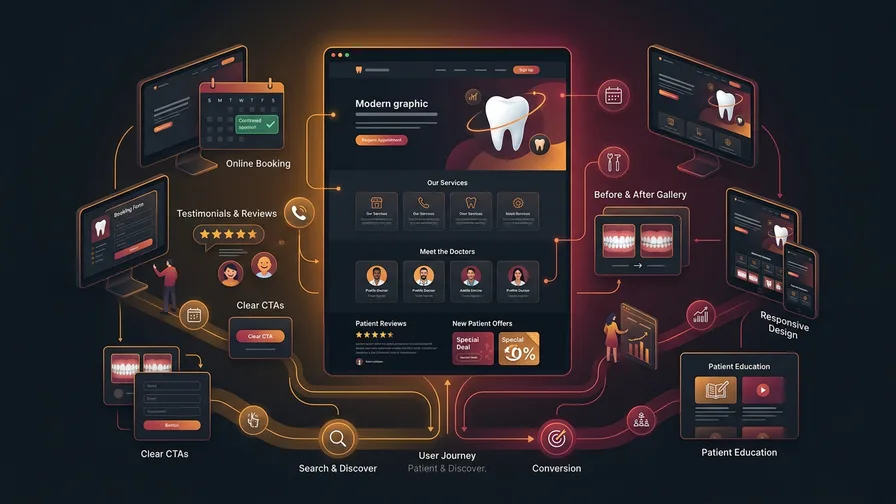
Clean, fast-loading design that works perfectly on mobile. This is non-negotiable. Your site needs to load in under three seconds, display properly on every device, and make it easy for people to find what they’re looking for. Form over function doesn’t work here. Function is what converts.
Prominent, obvious ways to book appointments. Big, colourful buttons that say “Book Now” or “Schedule Appointment” should appear at the top of every page. Your phone number should be clickable on mobile. If you offer online booking, that option should be front and centre. Make it effortless.
Real photos of your actual practice, team, and office. Ditch the stock photos. Patients want to see who they’ll be meeting and what your office actually looks like. Authenticity builds trust in ways polished stock imagery never will.
Patient testimonials and Google reviews displayed prominently. Social proof is everything for dental practices. If you have 200 five-star Google reviews, that should be one of the first things visitors see. If you have video testimonials from happy patients, even better. Show the proof.
Clear, helpful content about your services. Write service pages that actually explain what’s involved in each procedure, what patients can expect, how long it takes, and what the recovery is like. Answer the questions people are too nervous to ask. Be genuinely helpful, not salesy.
Strong local SEO foundation. Your website needs to be optimised for local searches with location-specific content, proper schema markup, consistent citations across directories, and a strategy for building quality backlinks. This is what makes you visible when potential patients are actually searching.
Custom design that reflects YOUR practice specifically. Not a template that 50 other dentists in your city are using. Your website should look and feel like your practice, communicate your unique value, and give people a genuine reason to choose you over competitors.
A reason to choose you over everyone else. Whether that’s your technology, your approach to anxious patients, your convenient hours, your experience, or your personality, your website needs to clearly communicate why someone should book with you specifically.
None of this is optional if you want your website to actually generate patients. These aren’t nice-to-have features, they’re fundamental elements of a website that works.
Should You DIY or Hire a Professional for Your Dental Website?
The DIY dental website is tempting. Platforms like Wix, Squarespace, and dental-specific website builders promise you can have a professional-looking site up and running in a weekend for under $500.
And to be fair, for some practices, that might be enough. If you’re a solo practitioner in a small town with limited competition, not trying to grow aggressively, and comfortable learning the technical side yourself, a DIY approach could work temporarily.
But here’s what you’re giving up.
Most website builders use templates, which means your site will look similar to countless other dental practices. You’ll be limited in customisation, especially when it comes to the local SEO elements that actually drive patient inquiries. The platforms handle basic responsiveness, but they rarely create the conversion-optimised experience that professional designers build.
You’ll also spend dozens of hours learning the platform, troubleshooting issues, trying to figure out SEO, and keeping everything updated. That’s time you’re not spending with patients or growing your practice. For most dentists, that time is worth far more than the money saved on a DIY website.
The bigger issue is that most DIY websites don’t generate patients effectively. They’re fine as a basic online presence, but they don’t rank well in local search, don’t build trust efficiently, and don’t convert visitors into appointments at the rate a professionally designed site does.
Professional web designers who specialise in dental practices understand the industry differently than generic website builders. They know what elements actually convert hesitant website visitors into booked appointments. They understand local SEO for healthcare. They know how to structure content so Google ranks you for the searches that matter. They build custom designs that differentiate you from competitors.
The question isn’t really whether you can build a dental website yourself. You probably can. The question is whether that website will actually bring in enough new patients to justify the investment of your time. For most practices, the answer is no.
If you’re serious about using your website as a patient acquisition tool rather than just an online placeholder,professional website design is worth every dollar. You’ll see the return in new patient bookings within months.
Your Next Steps to Fix Your Dental Practice Website
If you’re reading this and recognising problems with your current website, here’s what to do next.
Start with a basic audit. Check your site on your phone. How long does it take to load? Is it easy to navigate? Can you book an appointment in under 30 seconds? Does it look different from your competitors’ sites? Are your Google reviews visible?
Then search for your practice on Google using terms patients would actually use. “Dentist in [your city]” or “family dentist near me.” Where do you show up? If you’re not on the first page, you have an SEO problem that needs fixing.
Check your Google Business Profile. Is all your information accurate and consistent with what’s on your website? Do you have reviews? Are you responding to them? This is often the quickest win for improving local visibility.
Look at your analytics if you have them set up. How much traffic is your website actually getting? Where are people dropping off? Which pages do they visit? This data tells you what’s working and what’s not.
If your site has obvious problems like being slow, not mobile-friendly, or looking identical to competitor templates, you need to decide whether it’s worth trying to fix or whether you’re better off rebuilding from scratch. Sometimes patching problems on a fundamentally flawed website costs more than starting fresh.
For quick improvements you can make yourself, start with your calls-to-action. Make your phone number and booking options more prominent. Add Google reviews to your homepage. Update your content to actually answer patient questions instead of using generic marketing speak.
But if your website has multiple problems particularly around local SEO, mobile experience, or competitive differentiation, you’ll likely need professional help. The return on investment for a properly designed dental website that actually generates patients is significant enough that trying to DIY complex fixes rarely makes sense.
The goal isn’t to have a website that looks nice. The goal is to have a website that consistently brings qualified new patients into your practice. Everything else is secondary.
Frequently Asked Questions
How much should a dental practice website cost?
A professional dental website typically costs between $3,000 and $15,000 depending on complexity, custom features, and the level of SEO work included. Simple sites with basic pages and standard functionality fall on the lower end. Custom-designed sites with advanced features, extensive content, online booking integration, and comprehensive SEO fall on the higher end. Template-based sites through platforms like Wix or Squarespace cost $500-$2,000 but usually require significant time investment and rarely include proper local SEO. Factor in ongoing costs too, like hosting ($100-$500/year), maintenance, and updates. Cheap websites often end up costing more in lost patient opportunities than investing in professional design from the start.
How long does it take to redesign a dental practice website?
Most professional dental website redesigns take 6 to 12 weeks from initial planning to launch. This includes discovery and planning (1-2 weeks), design mockups and revisions (2-3 weeks), development and content creation (3-4 weeks), testing and refinement (1-2 weeks), and launch. Rush projects can sometimes be completed faster, but cutting corners usually means sacrificing quality in areas like SEO optimisation or content development. The timeline also depends on how quickly you can provide necessary content like photos, service descriptions, and team bios. After launch, ongoing SEO work continues for months as your site builds authority and rankings improve.
Can I update my dental website myself, or do I need a designer?
It depends what you’re updating. Most modern websites are built on content management systems like WordPress that let you edit text, add blog posts, update hours, and swap photos yourself without touching code. These updates are straightforward and you should be able to handle them. However, design changes, functionality additions, SEO improvements, and technical fixes usually require professional help unless you have web development skills. Trying to make major changes yourself often breaks things or hurts your search rankings unintentionally. The best approach is having a site that lets you handle routine content updates while having a professional available for anything more complex. Many web design agencies offer monthly maintenance packages that include technical updates, security monitoring, and performance optimisation.
Your dental practice website should be working harder than it currently is.
If you’re frustrated with a site that looks fine but doesn’t bring in patients, you’re not alone. Most dental websites have the same fixable problems, and addressing them makes a measurable difference in how many new patients find and choose your practice.

If your dental practice's website looks fine but isn't bringing in new patients, there's usually a fixable reason. Request a free website audit and we'll identify exactly what's holding your site back.