January 13, 2026
Why Dentists Switch Marketing Agencies (And When You Should)

TL;DR
Most dentists who switch marketing agencies wait too long to do it, then panic-switch for the wrong reasons. Here's how to tell when leaving makes sense, when staying is the better call, and what to do in the 90 days before either.
In This Article
Almost every dentist who has ever switched marketing agencies tells the same story. They knew it wasn't working for months. They held off because switching felt expensive, disruptive, or like an admission they'd picked the wrong agency in the first place. They waited too long. Then they switched in frustration to whoever pitched them next, and six months later they were having the same conversation about that agency too.
Switching is sometimes the right call. Tolerating a bad fit is never the right call. The trick is to know which one you're actually in. This article is for dentists who already have an agency and are starting to wonder whether to stay or leave.
If you're a US dentist reading this, the framework here applies on both sides of the border. Compliance details differ (HIPAA in the US versus provincial privacy laws in Canada such as Ontario's PHIPA or Quebec's Law 25, state versus provincial dental board rules), so adapt anything contract or privacy-related to your jurisdiction. We work with practices in both markets.
A note on any benchmarks in this article: timelines, switching frequencies, conversion rates, and similar figures are ballpark observations from current market conditions in Canadian dental marketing, not published authoritative benchmarks. Treat them as planning anchors and weigh them against your own production data and contract specifics.
The Real Cost of Switching (So You Don't Switch in Panic)
Switching marketing agencies isn't free, even when the new contract looks cheaper. The hidden costs:

- Transition friction. Two to four weeks of onboarding where the new agency learns your practice, your patient mix, your services. During that time, momentum on your existing campaigns usually drops.
- Lost institutional knowledge. Your old agency knew your seasonal patterns, your highest-converting service pages, which campaigns produced and which didn't. The new agency has to relearn all of that from data and conversations, which takes months.
- Ad account history reset risk. If you don't keep ownership of your Google Ads account and your historical data, you may be restarting campaign learning from zero with the new agency.
- Reporting comparison gets harder. Year-over-year comparisons get complicated when the methodology changes mid-stream.
- Your team's time. Onboarding calls, brand questionnaires, content reviews. Time you're not spending on patients.
None of this is a reason to stay with a bad agency. It's a reason not to switch on impulse. The right move is usually a structured 90-day window first, which we'll get to.
Patterns That Justify Switching
These aren't every-once-in-a-while frustrations. These are sustained patterns over multiple months that signal the relationship has stopped working.
1. Monthly reports tell you what happened, not what came back
You see impressions, clicks, rankings, post counts, and CTRs. You can't tell from the report how many new patients booked from marketing or what the math was on the ad spend. When you ask, you get a soft answer or another dashboard. We covered the standard for outcome-oriented reporting in our look at what dental marketing ROI actually looks like.
2. Underperformance is met with "the market is harder"
Every program has weak months. The question is what the agency does about them. A good agency flags the issue early, runs a diagnostic, proposes specific changes, and adjusts. A weaker one sends the same report and explains why it's not their fault. If you've heard "algorithm change," "market conditions," or "we're seeing this across all clients" more than twice in a row without a concrete change in approach, that's the pattern.
3. You don't know what you own
The website is on a platform you can't move. The Google Ads account is in their name. The analytics property is theirs. The blog content lives on their CMS. Each of these is a small concession on its own. Combined, they mean if you leave, you start from scratch. We talked about ownership terms in our guide on how to choose a dental marketing agency. If you didn't get those terms right at the start, you can sometimes renegotiate. If you can't, that's a switching signal.
4. Account manager churn
Your third account manager in twelve months. Each one needs to relearn your practice. Each handoff loses context. If the agency can't keep the same person on your account for a year at a stretch, the work suffers and you're the one paying for the relearning curve.
5. The agency stopped learning your business
In the first three months, they asked good questions about your services, your patient mix, your competitors, your goals. By month twelve, they're running the same monthly playbook regardless of what's happening at your practice. They don't know you've added implants, dropped pediatric, opened a second op. The work is on autopilot.
6. Communication has broken down
You email and don't hear back for three days. Changes you request take weeks. Strategy calls get rescheduled or skipped. The pattern matters more than any single incident. If you're the one chasing your agency, the dynamic is already wrong.
7. Spend is rising without results rising with it
Your ad budget went up. Your retainer crept up. New patient numbers didn't. When you ask why, you get general explanations rather than a clear plan to fix it. Marketing returns rarely scale perfectly linearly with investment (diminishing returns, market saturation, and chair capacity all play a role), but you should see directional movement when spend increases meaningfully. If you don't, something specific is broken and you need a specific answer.
Patterns That Look Like Switch Signals But Usually Aren't
Some things feel like agency problems and aren't. Switching on these reasons usually leads to the same outcome with the next agency.

- One slow month or quarter. Patient flow has seasonality (summer dips, post-holiday slumps, March break in markets with school-year families). One soft month isn't a pattern.
- An algorithm or platform change everyone is affected by. Google updates, iOS privacy changes, ad platform shifts. If the agency is responding intelligently and the impact is industry-wide, switching won't help.
- You moved the goalposts. If you signed up for steady patient flow and now want aggressive growth, that's a scope conversation, not an agency change. Tell the agency what you actually want before assuming they can't deliver it.
- Your team's operational issues. Long phone wait times, slow callbacks, front-desk lead-to-booking conversion under 60 to 70 per cent. Marketing can deliver calls. It can't pick them up for you. If you have an operational gap, switching agencies won't fix it.
- You haven't given them enough runway. SEO work doesn't show meaningful results for 4 to 12 months in competitive Canadian dental markets. Google Ads typically needs 30 to 60 days to stabilize after launch. If you're 90 days in and already switching, you almost never gave the work enough time.
The 90-Day Recovery Window Before Switching
If the patterns above ring true, don't switch this week. Run a structured 90-day recovery window first. It either gets the relationship back to working, or it gives you clean evidence that switching is the right call.
Free Consultation
Ready to get more from your marketing?
Book a free call and we'll look at what's working, what's not, and where to focus next.
Book a Free CallHere's the process:
1. Document the specific issues with examples. Not "the reports aren't great" but "the last three monthly reports didn't show what came back from the $2,500 in ad spend, only the impressions." Specifics give the agency something concrete to fix and you something concrete to evaluate.
2. Have a direct conversation with whoever leads your account. Share the documented issues. Ask what changes they're going to make in the next 90 days. Get the answer in writing.
3. Define what "back on track" looks like. Be specific. "Monthly reports include patient calls and bookings by channel, with a written narrative of what changed." "Front-desk lead-to-booking conversion is being measured." "Account manager is responding within one business day." Whatever your specific issues are, write the resolution as testable criteria.
4. Hold a checkpoint at day 45. Half-way through, review whether the changes are happening. If they're not, you have your answer earlier.
5. Hold the final review at day 90. If the criteria are met, the relationship is salvaged. If they're not, you have a clean reason to switch and a clear paper trail.
This process feels slow when you're frustrated, but it almost always saves you from switching to a worse fit or staying in a bad one for another year.
If You Decide to Switch, Do It Carefully
Once you've decided to leave, the transition itself matters. Common mistakes:
- Signing the new contract before sorting ownership of the old work. Make sure the website code, ad accounts, analytics property, domain, content, and brand assets are yours and you can move them. If they're not, get that resolved before you start the new contract.
- Skipping the overlap window. Where possible, run 30 to 60 days of overlap. Old agency wraps up clean, new agency onboards while campaigns continue running. Going dark for two weeks while you switch creates a gap in lead flow that's harder to recover from than the overlap cost.
- Not telling the old agency early. Awkward as it's, give the agency you're leaving 30 days notice (or whatever your contract specifies). It gives them time to do a proper handover, which means your new agency starts faster.
- Picking the next agency the same way you picked the last one. If you ended up with the wrong fit once, the selection process probably has a flaw. Use the questions in our guide to choose a dental marketing agency and lean on verifiable, public proof of past work rather than pitch quality.
What Switching Costs You vs What Tolerating Costs You
Practices weigh the cost of switching as if it's the only cost. The cost of tolerating a misfit agency is usually larger and just less visible.
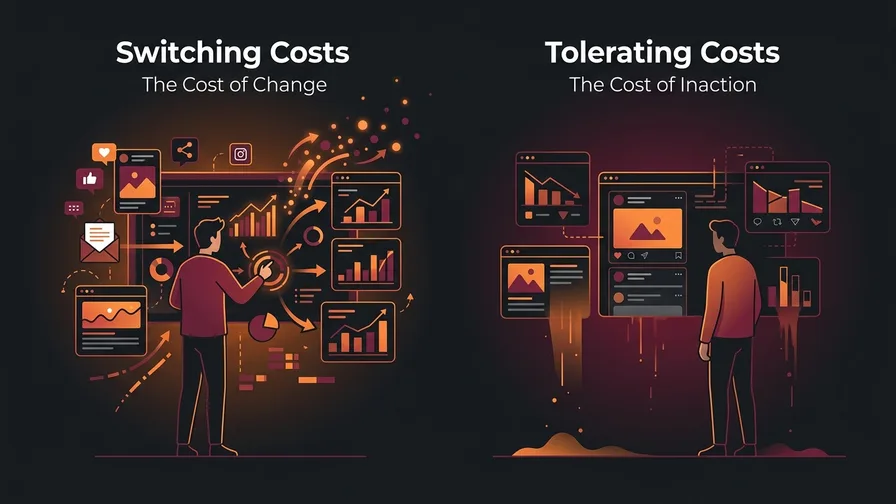
Six months of weak new patient flow at a competitive Canadian metro can mean tens of thousands in lost production. Lost production compounds because each patient missed is also the lifetime value of that patient and any referrals they would have brought. Meanwhile, the visible cost of switching (transition friction, learning curve) is mostly a one-time event measured in weeks.
If the patterns above describe your current relationship and the 90-day recovery doesn't move them, switching is the cheaper option even when it doesn't feel like it.
Frequently Asked Questions
How often do dental practices switch marketing agencies?
There isn't a clean industry benchmark, but agency-side surveys and dental industry commentary suggest practices that switch tend to do so roughly every 18 to 36 months. Switching every year usually signals a problem with how the practice is selecting agencies (not enough due diligence on each pick) rather than the agencies themselves all being bad.
What's the right time of year to switch dental marketing agencies?
Switch during your slower production stretches, not your busy ones, so any transition gap in lead flow has less impact. Honestly, dental seasonality is messier than most "best month to do X" articles admit. Late November and December tend to be busy in most practices (patients using up insurance benefits before they reset on December 31). January and February are also commonly busy because of fresh benefits and crown work, though some practices see a financial holiday hangover and call them quieter. March through June often runs strong for families booking before summer. The most consistently quieter stretches across Canadian practices are mid-July through August (vacations and kids out of school) and the back-to-school lull in September. The honest answer is to use your own production history to find your real slower months, since the patterns differ by demographic and region, then schedule the transition into that window.
What if my contract has a long notice period or auto-renewal?
Read the contract carefully. The standard for marketing agency contracts is a 30-day cancellation notice, but some agencies use longer windows of 60 to 90 days, especially on annual contracts with auto-renewal. If your renewal date is approaching, give notice on time even if you haven't picked a new agency. You can always renew if you change your mind, but missing the cancellation window forces you to pay for another full term. If you find a "site held hostage" clause that tries to lock your website or content to the agency, talk to a lawyer about whether it's enforceable in your jurisdiction.
Should I tell my agency I'm thinking about leaving?
The 90-day recovery window approach above is essentially that conversation, structured. Telling them you're frustrated and want specific changes is more productive than ghosting them and switching cold. Some relationships recover when the agency realizes they're at risk. Many of the worst outcomes happen when the dentist accepted the issues silently for too long.
How do I know if the new agency is actually different from the old one?
Don't take the pitch at face value. Look at their actual work: case studies with real numbers, public reviews, named testimonials from current dental clients. If their reporting samples look like the same dashboards you're already getting, they're not different just because they say they're. We covered the evaluation criteria in detail in how to choose a dental marketing agency.
If you're sitting in a marketing agency relationship that isn't working and trying to figure out whether to fix it or leave, book a call. We'll walk through what you have now, where the actual gaps are, and what a realistic path forward looks like, whether that's staying and resetting or starting over with someone else. If you're weighing a switch, here's how we handle dental marketing, so you can compare it with what you have now.