February 26, 2026
Veterinary Website Design: What Pet Owners Look for Before Choosing a Clinic
TL;DR
Pet owners choose a vet the way they choose a family doctor. They research, compare, and judge credibility before ever making a call. Your website needs to communicate trust, competence, and genuine care in seconds.
In This Article
Choosing a veterinarian is a deeply personal decision. Pet owners aren't shopping for a commodity. They're looking for someone they can trust with a family member's health. And for most people, that decision starts online.
Before a new client ever calls your clinic, they've already visited your website. They've looked at your team page, scanned your services, checked your hours, and formed an opinion about whether your practice feels like the right fit. If your website is outdated, hard to navigate, or missing key information, they move on to the next clinic without a second thought.
This guide covers what pet owners actually look for on a veterinary website and how to design a site that earns their trust and converts visits into booked appointments.
First Impressions Happen in Seconds
Research consistently shows that people form opinions about a website within the first few seconds of landing on it. For a veterinary clinic, those seconds need to communicate three things: professionalism, warmth, and competence.

That means your homepage needs to immediately show who you are, where you're located, and what you do. A clean layout with professional photos of your actual clinic and team does more than any stock image ever could. Pet owners can spot a generic template from a mile away, and it signals that you haven't invested in your practice's presentation.
Your homepage should also make it obvious how to take the next step. Whether that's booking an appointment, calling the clinic, or finding emergency information, those actions should be visible without scrolling. Don't bury the most important information below a wall of text or behind a dropdown menu.
If your current site looks like it was built five or more years ago, pet owners notice. Web design standards evolve, and a dated site creates doubt about whether your medical standards have kept up too. It's not fair, but it's how people think.
Online Booking and Appointment Requests
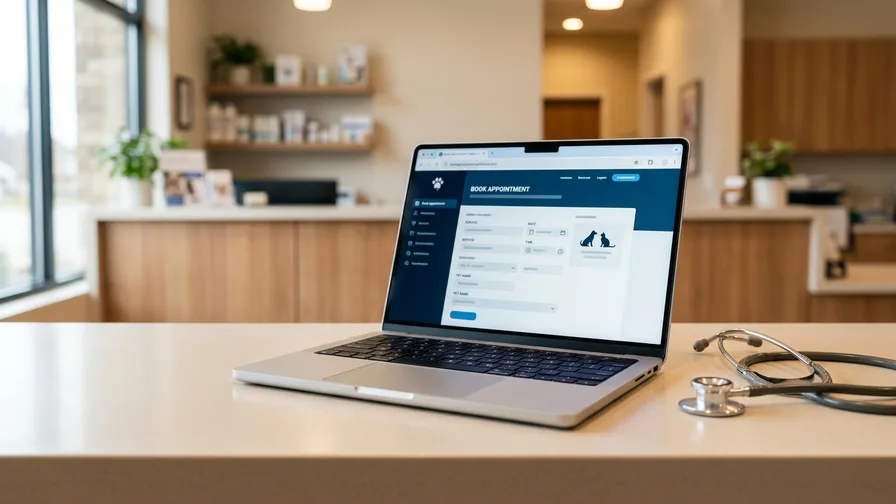
The single biggest conversion improvement most vet clinics can make is adding online booking or appointment request functionality to their website. Many pet owners prefer to book online rather than call, especially younger demographics who are now the fastest-growing segment of pet owners.
There are two approaches. Full online booking lets clients choose a date, time, and service and confirm the appointment instantly. Appointment request forms let clients submit their preferred time and details, and your team follows up to confirm. Either option is better than forcing every new client to pick up the phone during business hours.
Place your booking button prominently in your site's header so it's accessible from every page. Include it again on service pages and on your contact page. The fewer clicks between "I want to book" and actually booking, the more appointments you'll get.
If your practice management software offers a patient portal with online booking, integrate it directly into your website rather than linking out to a separate platform. Keeping the experience on your site feels more professional and reduces the chance of someone dropping off during the process.
Emergency Information Needs to Be Impossible to Miss
Pet emergencies are stressful, and panicked pet owners don't have the patience to hunt through your website for critical information. If you offer emergency or after-hours care, that information needs to be prominently displayed on every page of your site.
Consider adding a persistent banner or bar at the top of your website with your emergency phone number and hours. Something like: "Pet emergency? Call [number]. We're available [hours]." This should be visible on mobile without scrolling, because most emergency searches happen on phones.
If you don't offer emergency vet services, be upfront about that and direct visitors to the nearest emergency animal hospital. Including the name, address, and phone number of the closest emergency clinic is genuinely helpful, and pet owners will remember that you pointed them in the right direction when they needed it most. That goodwill often turns into a regular client relationship.
Create a dedicated emergency information page that covers what constitutes a pet emergency, what to do while you're on the way to the clinic, and what to bring. This page serves double duty: it helps panicked pet owners and it ranks in search engines for high-volume terms like "emergency vet," "24 hour vet," and "animal hospital near me" in your area.
Team Bios That Build Real Trust
Pet owners want to know who will be caring for their animal. A "Meet the Team" page with professional photos and genuine bios is one of the most visited pages on any veterinary website. Don't skip it or treat it as an afterthought.
Each veterinarian's bio should include their education and credentials, areas of special interest or expertise, years of experience, and something personal. Do they have pets of their own? What drew them to veterinary medicine? These details humanize your team and help pet owners feel a connection before they ever walk in.
Include your veterinary technicians and support staff too. Pet owners interact with your entire team, not just the doctors. Showing that you value your whole staff also says something positive about your clinic culture.
Use real photos, not headshots from a stock photo site. Photos of your team members with animals are ideal. They're warm, authentic, and they reinforce the message that your team genuinely cares about animals. A good photographer can capture these in under an hour, and the images will serve your website, social media, and Google Business Profile for years.
Service Pages That Answer Real Questions
When a pet owner is researching whether their cat needs a dental cleaning or what's involved in a spay surgery, they want detailed, honest information. Generic one-liners like "We offer dental services" don't cut it.

Each service page should explain what the procedure or service involves, why it matters for the animal's health, what the pet owner should expect before, during, and after the visit, and how to take the next step. This level of detail builds confidence and reduces the anxiety that often prevents people from booking.
If your clinic treats multiple types of animals, consider organizing your services by species as well as by service type. A pet owner with a rabbit has very different needs from someone with a Labrador, and they want to see that your clinic has specific experience with their type of animal.
For clinics that offer specialized services like orthopedic surgery, oncology, or rehabilitation, dedicated pages for these services are especially important. They signal expertise and help you rank in search results for those specific terms. Detailed service pages are also where your SEO strategy and your website design need to work together seamlessly.
Free Offer
Want to know what's actually hurting your website?
We'll review your site and tell you exactly what to fix, no strings attached.
Get Your Free AuditFacility Photos and Virtual Tours
Pet owners want to see where their animal will be treated. A clean, well-lit facility with modern equipment reassures them that their pet is in good hands. A website with no facility photos leaves that entirely to imagination, and imagination doesn't always work in your favour.
Photograph your waiting area, exam rooms, surgical suite, recovery area, and any outdoor spaces. If you have separate cat and dog waiting areas (a feature many pet owners specifically look for), highlight that. If your facility has been recently renovated or has notable equipment, show it off.
A short video walkthrough can make a real difference here. Walk through the front door, show the reception area, peek into an exam room, and introduce a couple of team members. It gives pet owners exactly what they're looking for: a sense of the space and the people who work there. Upload it to your website and your Google Business Profile for maximum visibility.
This is particularly effective for pet owners with anxious animals who want to familiarize themselves with the space before a visit. If you want to take it a step further, a 360-degree virtual tour embedded on your site or hosted on Google is an option, but for most clinics a simple video walkthrough delivers the same reassurance at a fraction of the cost.
Client Testimonials and Social Proof
Reviews on Google are essential for local SEO, but testimonials on your website serve a different purpose. They let you showcase the stories and experiences that best represent what your clinic offers.
The most effective veterinary testimonials are specific. "They saved my dog's life during an emergency at 2 a.m." is more powerful than "Great vet, highly recommend." Look for reviews that mention specific services, specific team members, or specific outcomes. Ask permission to feature them on your site with the client's first name and their pet's name.
Place testimonials strategically throughout your site, not just on a dedicated testimonials page. Include a relevant testimonial on each service page. Put one or two on your homepage. Add them near your booking button as a final nudge of reassurance.
If clients have shared photos of their pets (especially before and after treatment, or happy recovery photos), ask if you can feature those alongside their testimonial. Visual social proof is more memorable and more persuasive than text alone.
New Patient Information and What to Expect
New clients have questions. What paperwork do they need? Should they bring previous medical records? How early should they arrive? What payment methods do you accept? Do you offer payment plans?
A dedicated "New Patients" or "Your First Visit" page that answers all of these questions removes friction from the booking process. It shows that you've thought about the client experience from their perspective, which is exactly the kind of attention to detail pet owners want from their vet.
If your practice uses new patient forms, make them digitally fillable and submittable directly on your website rather than offering a PDF download. Online forms that clients can complete and submit from their phone or computer before the appointment save time for everyone, reduce stress for anxious pets who don't enjoy extra time in a waiting room, and give your front desk the information they need before the client walks in.
If you accept pet insurance, list the providers you work with. If you offer financing or payment plans for major procedures, make that clear. Cost is a real concern for pet owners, and being transparent about it builds trust rather than undermining it.
Mobile-First Design for Urgent Searches
More than half of all veterinary searches happen on mobile devices, and for urgent searches like "emergency vet near me" or "veterinarian near me," that number is even higher. Your website absolutely must work flawlessly on a phone screen.

Mobile-first design isn't just about making your desktop site smaller. It means designing the mobile experience first and ensuring that the most important elements, your phone number, booking button, emergency information, and address, are immediately accessible without pinching, zooming, or scrolling through a hamburger menu.
Your phone number should be a tap-to-call link. Your address should link to maps. Your booking button should be large enough to tap easily. Page load speed matters even more on mobile, where connections are often slower and patience is shorter. A site that takes more than three seconds to load on a phone will lose a significant percentage of visitors before they see a single word of content.
Test your website on an actual phone, not just a desktop browser resized to a narrow window. The experience often differs in ways that desktop testing misses: touch target sizes, scroll behaviour, form usability, and image loading all behave differently on real mobile devices.
Frequently Asked Questions
How much does a veterinary website cost?
A professional veterinary website typically ranges from $3,000 to $10,000 depending on the number of pages, custom functionality like online booking integration, and the level of custom design involved. Template-based sites cost less but often lack the flexibility and performance optimization that help you stand out in search results and convert more visitors into clients.
Should my vet website have a blog?
Yes. A blog with helpful pet health content serves two purposes: it brings new visitors to your site through search engines, and it positions your clinic as a trusted authority. You don't need to publish every week. Even one or two well-written posts per month on topics pet owners actually search for can make a meaningful difference over time.
How important are photos on a veterinary website?
Extremely important. Pet owners want to see your facility, your team, and real animals in your care. Stock photos of smiling people holding puppies don't build the same trust as genuine images from your actual clinic. Invest in a professional photo session at least once. The images will serve your website, Google Business Profile, and social media for years.
Do I need online booking on my vet website?
It's becoming expected rather than optional. Younger pet owners in particular prefer booking online to calling. At minimum, offer an appointment request form. If your practice management software supports direct online booking, integrating it into your website will noticeably increase the number of appointments you receive.
How often should I update my veterinary website?
Review your website at least quarterly. Update team bios when staff changes occur, add new services as they become available, refresh your photo gallery, and keep your hours and contact information current. An outdated website with old staff photos or discontinued services erodes trust quickly. Search engines also favour websites that are regularly updated with fresh content.
Your website is the first real interaction most pet owners will have with your clinic. If it's outdated, hard to use, or missing the information they need, they'll choose a competitor who made it easier. We build veterinary websites that look professional, work on every device, and turn visitors into loyal clients. Start with a free website audit and we'll show you exactly what's holding your current site back and how to fix it.