February 21, 2026
SEO for Landscaping Companies: How to Rank When Homeowners Search for Help

TL;DR
Most homeowners start their search for a landscaper online. If your company doesn’t show up when they type “landscaper near me,” you’re losing jobs to competitors who invested in their online presence.
In This Article
When a homeowner decides they need help with their yard, whether it's a patio installation, a full landscape design, or regular lawn care, they almost always start with a search. They type something like "landscaper near me," "lawn care services," or "patio builders in [city]" and scroll through the results. If your landscaping company doesn't appear in those results, you don't exist to that homeowner. They'll call whoever does show up.
The frustrating part is that many landscaping companies do excellent work but have almost no online visibility. They rely on word of mouth, yard signs, and maybe a Facebook page. Those channels still matter, but they can't compete with the volume of leads that come through Google every single day. A strong search engine optimization strategy puts your business in front of homeowners at the exact moment they're ready to hire.
This guide covers the specific SEO tactics that work for landscaping companies, from local search fundamentals to seasonal keyword strategies and content that actually brings in leads.
Why Local SEO Is the Foundation for Landscaping Companies
Landscaping is inherently local. You're not competing with companies across the country. You're competing with the other landscapers in your city or region. That's why local SEO is the single most important piece of your online marketing strategy.

Local SEO is the practice of optimizing your online presence so you appear in location-based searches. When someone searches "landscaping company in Brantford," "lawn care near me," or "gardening services [city]," Google uses a combination of signals to decide which businesses to show. Those signals include your Google Business Profile, your website content, online reviews, citations (directory listings), and how consistent your business information is across the web.
The local pack, the three map listings that appear at the top of most local searches, is where you want to be. Those listings get the majority of clicks for service-based searches. Ranking in the local pack means more calls, more quote requests, and more jobs. Everything we cover in this guide feeds into that goal.
Optimizing Your Google Business Profile for Seasonal Businesses
Your Google Business Profile is the backbone of your local search presence. For landscaping companies, it needs extra attention because your services shift with the seasons.
Start with the basics. Make sure your business name, address, and phone number are accurate and match exactly what appears on your website and directory listings. Choose "Landscaper" or "Landscaping Company" as your primary category, and add secondary categories for specific services you offer, like "Lawn Care Service," "Snow Removal Service," or "Garden Designer."
Here's where landscaping companies have a real advantage: photos. Google Business Profile rewards businesses that post photos regularly, and landscaping is one of the most visual industries out there. Upload high-quality photos of completed projects, before-and-after shots, your crew in action, and your equipment. Aim to add new photos at least once a month. Google notices the activity, and potential customers notice the quality of your work.
Update your profile with seasonal information throughout the year. In spring, highlight garden design, sod installation, and spring cleanups. In summer, showcase outdoor living spaces and maintenance packages. In fall, promote leaf removal and garden winterization. In winter, feature snow removal and ice management. Google Business Profile lets you create posts, and those posts are a perfect place to announce seasonal services and promotions.
Reviews matter enormously for local rankings. After every completed job, ask the homeowner to leave a Google review. Make it easy by sending them a direct link. Respond to every review, positive or negative, with a genuine, specific reply. A steady stream of recent reviews tells Google your business is active and trusted. For more on making the most of your profile, our SEO team can walk you through a full local optimization plan.
Building Service-Specific Pages That Rank
One of the biggest SEO mistakes landscaping companies make is cramming all of their services onto a single page. A homepage that says "We do landscaping, lawn care, hardscaping, snow removal, and garden design" gives Google almost nothing to work with. It doesn't know which searches to show you for, so it often shows you for none of them.
Instead, create dedicated pages for each major service you offer. Each page should target the specific keywords homeowners use when searching for that service. Here's what that looks like in practice:
Lawn care and maintenance: Target phrases like "lawn care services [city]," "lawn maintenance near me," "weekly lawn mowing [area]," and "yard work [city]." Cover what's included in your maintenance packages, how often you service properties, and what homeowners can expect.
Hardscaping: Target "patio installation [city]," "retaining wall builders near me," "interlock driveway [area]." Show examples of completed projects, explain materials you work with, and discuss the process from design to completion.
Snow removal: Target "snow removal service [city]," "commercial snow clearing [area]," "residential snow plowing near me." Explain your response times, service areas, and what's included in seasonal contracts.
Garden design and planting: Target "landscape design [city]," "gardening services near me," "garden designer [city]," "perennial garden installation [area]." Landscape design is one of the most frequently searched landscaping terms in Canada, making it one of the most valuable service page keywords. Highlight your design process, plant selection expertise, and how you work with the local climate.
Each service page should be at least 800 words and include your service area, the specific benefits homeowners get, photos of relevant completed projects, and a clear call to action for requesting a quote. This structure gives Google clear signals about what you offer and where, which dramatically improves your chances of ranking for service-specific searches.
Seasonal Keyword Strategy: Ranking Year-Round
Landscaping is seasonal, and your SEO strategy should reflect that. The keywords homeowners search for change throughout the year, and if your content only targets summer services, you're invisible for eight months.

In early spring (March through April), searches spike for "spring cleanup services," "garden bed preparation," "sod installation," and "landscape design." This is when homeowners are planning their projects for the year. Your content should be live and optimized well before spring arrives, ideally by late winter, because it takes time for pages to rank.
Summer (May through August) brings searches for "patio builders," "outdoor kitchen installation," "lawn maintenance," and "irrigation system installation." This is peak season for most landscapers, and competition for these keywords is highest.
Fall (September through November) sees searches for "fall leaf cleanup," "garden winterization," "aeration and overseeding," and "tree and shrub pruning." Many landscapers ignore fall content, which means there's less competition and a real opportunity to rank.
Free Offer
Want to know what's actually hurting your website?
We'll review your site and tell you exactly what to fix, no strings attached.
Get Your Free AuditWinter (December through February) is dominated by "snow removal," "ice management," "salting services," and "winter property maintenance." If you offer snow removal, this is a revenue stream that keeps your business busy year-round, and it deserves its own dedicated content strategy.
Blog posts are a great way to capture seasonal search traffic. Write about topics homeowners are actively searching for: "When should I aerate my lawn in Ontario?", "How much does a patio cost?", "Best plants for shade gardens in Southern Ontario," or "lawn maintenance tips for Canadian homeowners." Each post brings in search traffic and positions your company as the local authority.
Before-and-After Content: Your Strongest SEO Asset
Landscaping is visual. The difference between a tired, patchy backyard and a finished outdoor living space is dramatic, and that transformation is exactly what homeowners want to see before they hire someone.
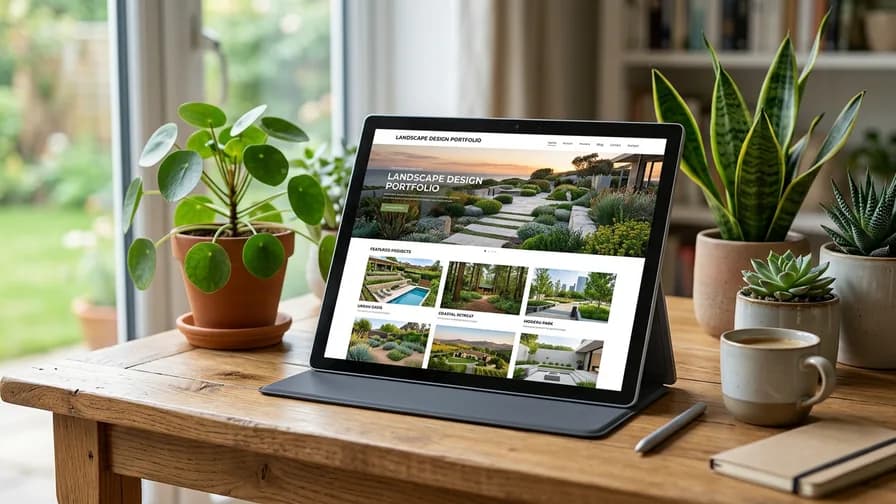
Before-and-after project galleries do double duty. They convince potential customers that you can deliver results, and they give Google rich, relevant content to index. Each project page or gallery entry should include high-quality photos from multiple angles, a description of the work performed, the location (city or neighbourhood), and the services involved.
Don't just dump photos into a gallery with no context. Write a short case study for each project. Explain what the homeowner wanted, what challenges you faced (drainage issues, grading problems, awkward lot shapes), and how you solved them. This kind of content naturally includes the keywords homeowners search for, and it builds trust by showing your problem-solving ability.
Name your image files descriptively before uploading them. Instead of "IMG_4521.jpg," use "backyard-patio-installation-brantford-before.webp" and "backyard-patio-installation-brantford-after.webp." Write alt text that describes what's in the photo. These details help your images appear in Google Image Search, which is another source of traffic for landscaping companies.
If you're doing great work but nobody can see it online, you're leaving money on the table. A well-organized project gallery, combined with a strong website design, turns your portfolio into a lead generation machine.
Building Citations and Local Authority
Citations are mentions of your business name, address, and phone number on other websites. They're one of the key ranking factors for local SEO, and for landscaping companies, there are plenty of places to build them.
Start with the major directories: Google Business Profile, Bing Places, Yelp, and Yellow Pages. Then move to industry-specific directories like HomeStars, Houzz, Landscape Ontario's member directory, and your local chamber of commerce. Each listing should have your exact business name, address, and phone number, consistent down to the abbreviation. If your website says "St." but a directory says "Street," that inconsistency can hurt your rankings.
Beyond directories, look for local citation opportunities. Sponsor a community event and get listed on their website. Join your local business improvement area. Get listed on your municipality's business directory. These local signals tell Google that your business is established and connected to the community.
Don't forget about Landscape Ontario and similar provincial associations. Membership in professional associations adds credibility to your business, and the backlink from their directory is valuable for SEO. If you hold any certifications (Certified Landscape Professional, for example), make sure those are mentioned on your website and in your directory listings.
Making Your Website Work Harder
All of the SEO tactics above feed into your website, which is the hub of your online presence. A few technical and structural elements can make a big difference in how well your site ranks.

Make sure your website loads fast, especially on mobile. Homeowners searching for landscapers are often on their phones, browsing while they're standing in their yard looking at the problem they want solved. If your site takes more than a few seconds to load, they'll hit the back button and call the next company.
Include your service area prominently. List the cities and towns you serve on your homepage, your service pages, and your footer. Create location-specific content if you serve multiple areas. A page targeting "landscaping services in Cambridge" will rank better for Cambridge searches than a generic page that doesn't mention any location.
Add clear calls to action on every page. "Get a Free Quote," "Request an Estimate," or "Book a Consultation" should be visible without scrolling. Make your phone number clickable on mobile. The easier you make it for someone to contact you, the more leads your website will generate.
Structured data (schema markup) helps Google understand your business information. At minimum, add LocalBusiness schema with your business name, address, phone number, service area, and hours. This can improve how your site appears in search results and increase your chances of appearing in the local pack.
Frequently Asked Questions
How long does SEO take to work for a landscaping company?
Most landscaping companies start seeing improved rankings within three to six months of consistent SEO work. Local SEO results, particularly Google Business Profile optimizations and review generation, can produce results faster, sometimes within weeks. The key is consistency. SEO compounds over time, and the businesses that maintain their efforts year-round see the strongest long-term results.
Do I need a blog for my landscaping website?
A blog isn't strictly required, but it's one of the most effective ways to capture seasonal search traffic and demonstrate expertise. Blog posts about common homeowner questions ("How much does a patio cost?", "When to aerate your lawn") bring in visitors who are actively looking for help. Those visitors become leads. Even one or two posts per month can make a meaningful difference over time.
How important are Google reviews for landscaping companies?
Extremely important. Reviews are one of the top ranking factors for the local pack, and they directly influence whether homeowners choose to call you. A landscaping company with 80 positive reviews will consistently outperform a competitor with 5 reviews, even if the competitor does great work. Ask every satisfied customer for a review, and make it as easy as possible by sending them a direct link.
Should I target "near me" keywords on my website?
You don't need to literally write "near me" on your pages. Google handles "near me" searches by using the searcher's location to find relevant local businesses. What you should do is make sure your location and service area are clearly stated on your website, your Google Business Profile is fully optimized, and your NAP (name, address, phone number) is consistent everywhere. That's what tells Google you're the "near me" result.
Can I do SEO myself, or do I need to hire someone?
You can handle some SEO basics yourself, like optimizing your Google Business Profile, asking for reviews, and writing blog posts. But technical SEO, site structure, keyword research, and link building often benefit from professional help. Most landscaping company owners are busy running crews and managing projects. Hiring an SEO professional lets you focus on your work while someone else makes sure homeowners can find you online.
If your landscaping company does great work but you're not getting the online visibility to match, we can help you change that. Start with a free website audit and we'll show you exactly where your site stands in local search, what's holding you back, and what to focus on first to start generating more leads from homeowners in your area.