December 30, 2025
Google Ads vs. SEO: Which One Should You Invest in First?
TL;DR
Both Google Ads and SEO drive traffic from Google. But they work differently, cost differently, and suit different situations. Here's how to choose the right starting point for your business.
In This Article
Every small business owner eventually asks this question. You've got a marketing budget and you want to spend it on Google, but you're not sure whether to invest in paid ads or organic SEO. The answer isn't the same for every business, but the logic that gets you there is.
Here's an honest comparison of both, and a framework for deciding which deserves your money first.
What Google Ads Actually Does
Google Ads puts your business at the top of search results for keywords you choose, and you pay each time someone clicks. The appeal is speed: campaigns can go live in hours and start generating traffic the same day. The downside is that it stops the moment your budget does. Turn off the ads, and the traffic disappears instantly.

The average cost per click across all industries is $4.66, according to WordStream's 2024 benchmarks, with an average conversion rate of 6.96%. For competitive industries like legal or dental, CPCs can run $6 to $9. For less competitive local services, they can be well under $3.
Our Google Ads management service covers campaign setup, keyword strategy, and ongoing optimization for Ontario businesses.
What SEO Actually Does
SEO improves your website's organic rankings for relevant searches. Unlike ads, you don't pay per click. Once you rank, traffic comes without ongoing spend. The tradeoff is time: most businesses see initial movement in 3 to 6 months, with significant results typically taking 6 to 12 months, especially in competitive markets.
The value compounds. A page ranking on page one continues bringing in traffic month after month, year after year, without additional cost per click. That makes SEO one of the highest-ROI marketing investments over a 2 to 3 year horizon, even if the upfront payoff is slower.
Our SEO service includes on-page optimization, content strategy, technical fixes, and local SEO for Ontario businesses.
The Key Difference: Timeline vs. Longevity
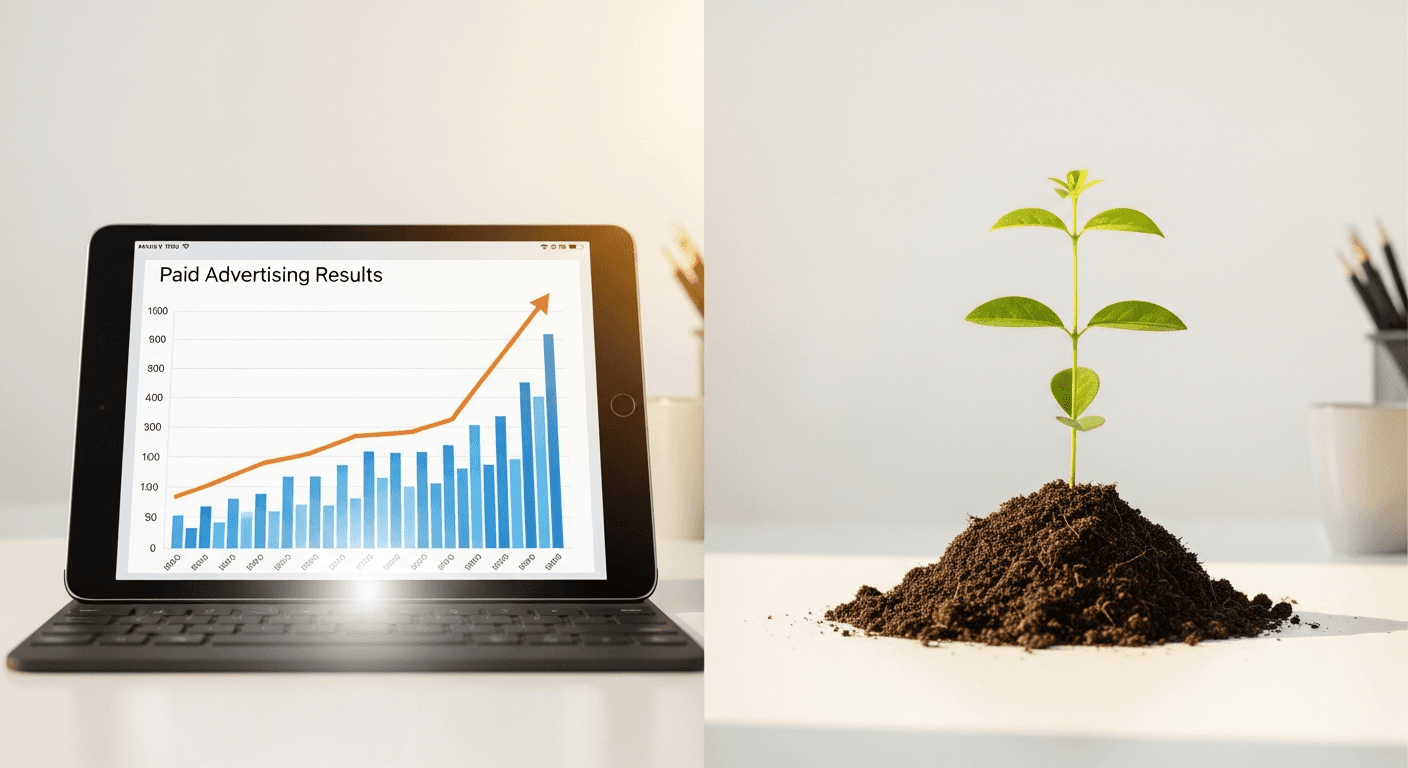
Think of it this way. Google Ads is a tap. Turn it on, water flows. Turn it off, it stops. SEO is a well you're digging. It takes time and effort to reach water, but once you do, the water keeps flowing without you continuing to dig.

The top 5 organic results capture roughly 67.6% of all clicks on a Google search results page, according to data cited by HiGo Creative via HubSpot. Paid ads appear above them, but many users scroll past. Getting into those top organic spots is worth working toward, even if it takes time.
Free Consultation
Ready to get more from your marketing?
Book a free call and we'll look at what's working, what's not, and where to focus next.
Book a Free CallWhich One Should You Start With?
There's no universal answer, but these questions will get you close:
Start with Google Ads if:
- Your business is new and has no organic search presence yet
- You need leads within the next 30 to 60 days
- You have a clear, high-margin offer and can calculate what a lead is worth
- Your target keywords are highly competitive organically
Start with SEO if:
- Your timeline for results is 6 to 12 months or longer
- You want to reduce dependence on paid traffic over time
- Your industry has high CPCs that eat into margins quickly
- You're playing a long game and want traffic that compounds
Do both if:
- You have the budget to run ads while SEO builds momentum
- You want to test which keywords convert before committing to SEO for them
- Your business is established and you want consistent growth across both channels
A Practical Approach for Most Small Businesses
The most common strategy we recommend for Ontario small businesses starting from scratch: use Google Ads to generate leads in the short term while simultaneously investing in SEO to build organic rankings. As your organic traffic grows over 6 to 12 months, you can reduce ad spend gradually without losing overall lead volume.

This approach requires more upfront budget, but it means you're not solely dependent on either channel. Paid ads are vulnerable to budget cuts. Organic rankings are vulnerable to algorithm changes. Diversification reduces that risk.
Frequently Asked Questions
Can I do both Google Ads and SEO on a small budget?
Yes, but you'll need to choose emphasis. A realistic starting point is splitting budget 60/40 in favour of whichever channel matches your timeline. If you need leads now, weight toward ads. If you're planning for 12 months out, weight toward SEO. You can rebalance as results come in.
Does running Google Ads help my SEO rankings?
No, not directly. Paid ads and organic rankings are separate systems. Running ads does not boost your organic positions. However, well-structured ads can help you test which messaging and keywords resonate with your audience, which informs your SEO content strategy.
What if I can only afford one?
If you need revenue in the next 60 days, choose ads. If you're building for the next 12 months and have some patience, choose SEO. The honest answer is that SEO compounds more favourably over time, but it won't pay this month's bills.
Not sure which channel makes more sense for your specific business? Book a call with us and we'll give you a straight answer based on your industry, your competition, and your budget.